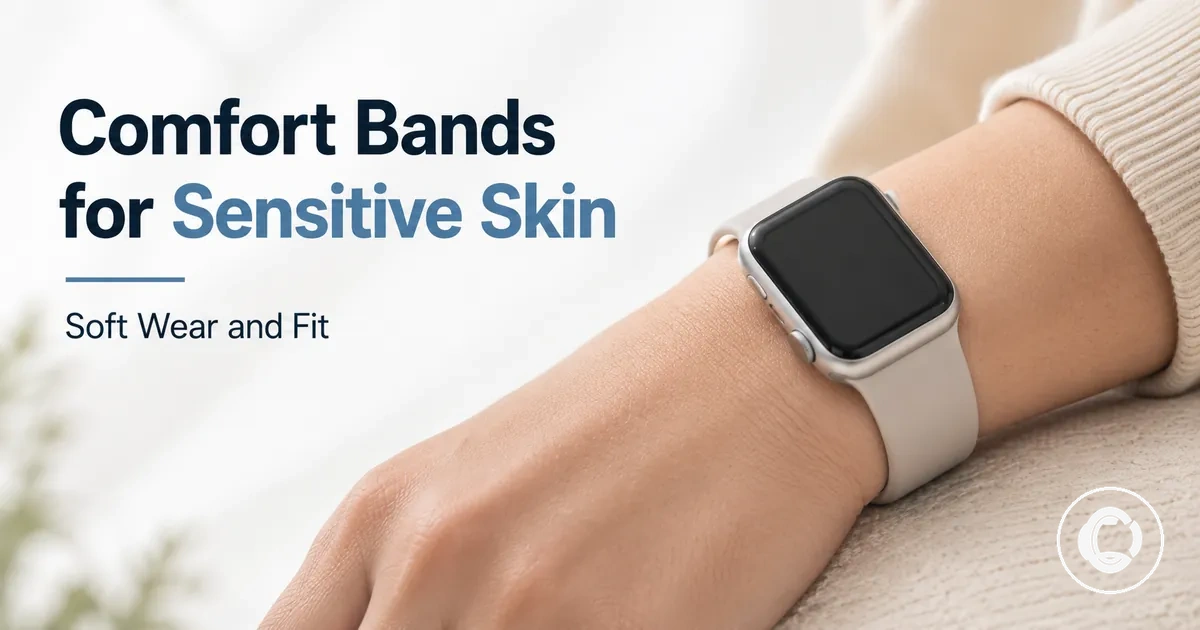
Smartwatch bands for sensitive skin and comfortable daily wear
Smartwatch bands for sensitive skin are replacement straps chosen for comfort, skin contact, and daily wear conditions rather than style alone. A comfortable band should help the wearer evaluate how the strap touches the wrist, how tightly it sits, and how well the contact area handles heat or sweat. For sensitive skin, the main decision factors are material, fit, breathability, moisture, and allergen exposure.
Daily comfort can vary because sensitive skin may react differently to rubbing, trapped sweat, residue, metal hardware, dyes, coatings, or long wear time. A band that feels soft for one wearer may still feel irritating if it traps moisture, sits too tightly, or leaves residue against the wrist. This page focuses on choosing lower-irritation band qualities before comparing examples, while irritation causes and cleaning remain supporting contexts within the broader smartwatch bands guide.
The safest starting point is a criteria-based choice: look for a band with a gentle contact surface, adjustable pressure, breathable construction, and cleaning needs that match how often the watch is worn. Hypoallergenic or skin-friendly labels can be useful screening signals, but they should not replace checking material disclosure, hardware contact, fit, and moisture behavior.
What makes a smartwatch band safer for sensitive skin
A safer smartwatch band reduces irritation risk by limiting harsh skin contact, friction, trapped moisture, wrist pressure, and likely allergen exposure. It should feel gentle against the wrist without claiming rash-free wear. For sensitive skin, safer means lower-risk wear conditions, not a guaranteed comfort outcome.
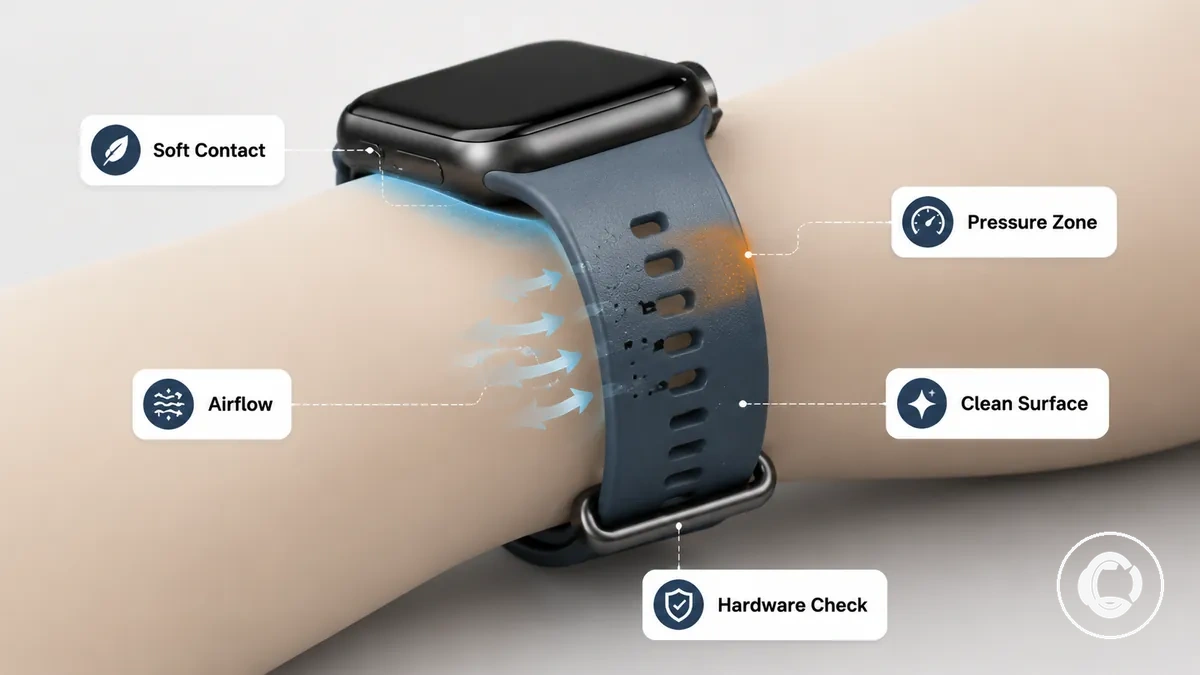
The main checks start with how the band touches the wrist. A smooth surface texture may reduce rubbing risk, while rough edges, bulky closures, or tight fastening can increase wrist pressure and leave marks. Metal hardware, coatings, dyes, or unknown materials may also matter when allergen exposure is a concern. A gentler band is usually the one that lowers these contact and pressure risks for the wearer.
Sweat, soap, skin oils, and dust can create residue buildup when a band sits against the same area for long periods. If ventilation is poor, trapped moisture may stay under the strap and make rubbing feel worse. Material sensitivity, pressure irritation, and moisture-related discomfort can look similar, so the safer choice is the band that controls contact, airflow, and cleanliness together. Use the checklist below to verify those safer-wear factors before comparing band examples.
A lower-irritation band should pass practical comfort checks before it is treated as skin-safe. The checklist is not medical advice; it only helps separate band design, fit, and care factors that may affect sensitive-skin comfort.
- Check whether the contact area feels smooth, flexible, and free from rough strap edges.
- Choose closure pressure that feels secure without creating strong wrist marks.
- Look for ventilation through perforation, weave openness, or a design that allows airflow.
- Check whether the band surface can be kept clean enough to limit residue buildup.
- Review hardware, coating, dye, or material details when allergen exposure is a known concern.
Skin-friendly materials for comfort and lower irritation risk
Material choice is a key factor in selecting a lower-risk smartwatch band for sensitive skin. Different materials can change how the band feels against the wrist, how much moisture it retains, how easily it can be cleaned, and whether certain components may increase allergen exposure. The most suitable option usually depends on balancing skin contact, moisture management, and potential allergen exposure.
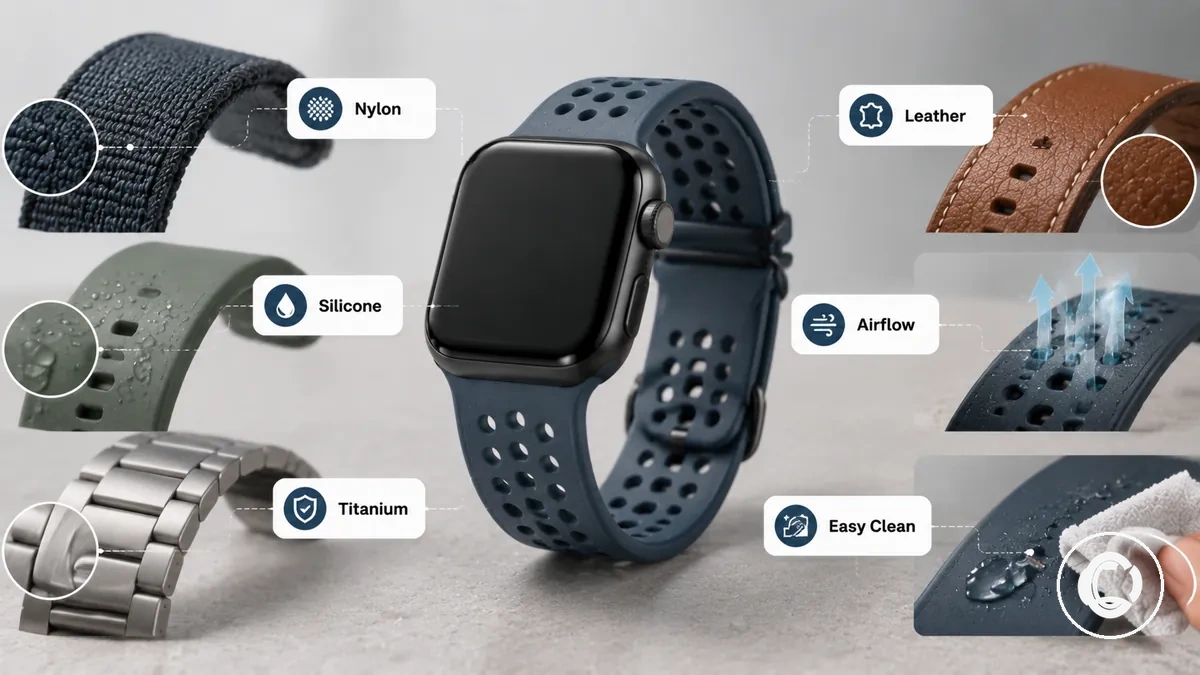
Smartwatch band materials can be grouped by how they interact with the skin during daily wear. Soft synthetic options may prioritise flexibility and easy cleaning, while woven constructions often focus on airflow and lighter contact. Metal and ceramic materials can offer smooth surfaces, but comfort may depend on hardware design, coatings, and individual sensitivity patterns. The comparison below contrasts materials by contact surface, moisture behaviour, and sensitivity considerations.
| Material | Contact Surface | Moisture Behaviour | Sensitivity Considerations |
|---|---|---|---|
| Nylon | Lightweight woven contact | Often allows airflow | Comfort may depend on weave texture and cleanliness |
| Woven Fabric | Soft flexible surface | Can improve ventilation | May require regular cleaning to limit residue buildup |
| Silicone | Smooth non-absorbent surface | Usually easy to rinse | Comfort depends on fit, sweat management, and skin response |
| Flexible Polymer | Flexible skin contact | Varies by design | Material blends and coatings may affect sensitivity risk |
| Titanium | Smooth rigid surface | May retain less moisture on the surface | Hardware finish and skin sensitivity can influence comfort |
| Ceramic | Smooth hard surface | May retain less surface moisture | Comfort varies by fit and contact pressure |
| Leather | Natural contact surface | May absorb moisture | Finishes, dyes, and wear conditions can affect comfort |
When a wearer already knows that certain materials, finishes, or hardware cause discomfort, narrowing choices by sensitivity triggers can simplify selection. Users seeking breathable options often compare woven constructions, while those prioritising easy rinsing may prefer smoother non-absorbent surfaces. Evaluating skin-friendly band materials also means considering coatings, dyes, and metal hardware rather than focusing only on the main strap material. A lower irritation risk usually comes from the overall material system rather than a single material label.
The most practical decision signals depend on individual wear conditions. Breathable materials may suit users who experience trapped moisture, lightweight constructions can reduce awareness of wrist contact, and easily cleaned surfaces may help limit residue buildup over time. No smartwatch band material is universally suitable for every wearer, so comfort outcomes often depend on fit, maintenance habits, environmental conditions, and personal sensitivity patterns.
Breathable nylon and woven fabric bands
Breathable nylon and woven fabric bands are lightweight smartwatch band options that prioritise airflow and flexible wrist contact. A fabric band can feel softer during extended wear when weave quality, strap construction, and adjustment fit suit the user. Comfort often depends on airflow, weave quality, and drying behavior.
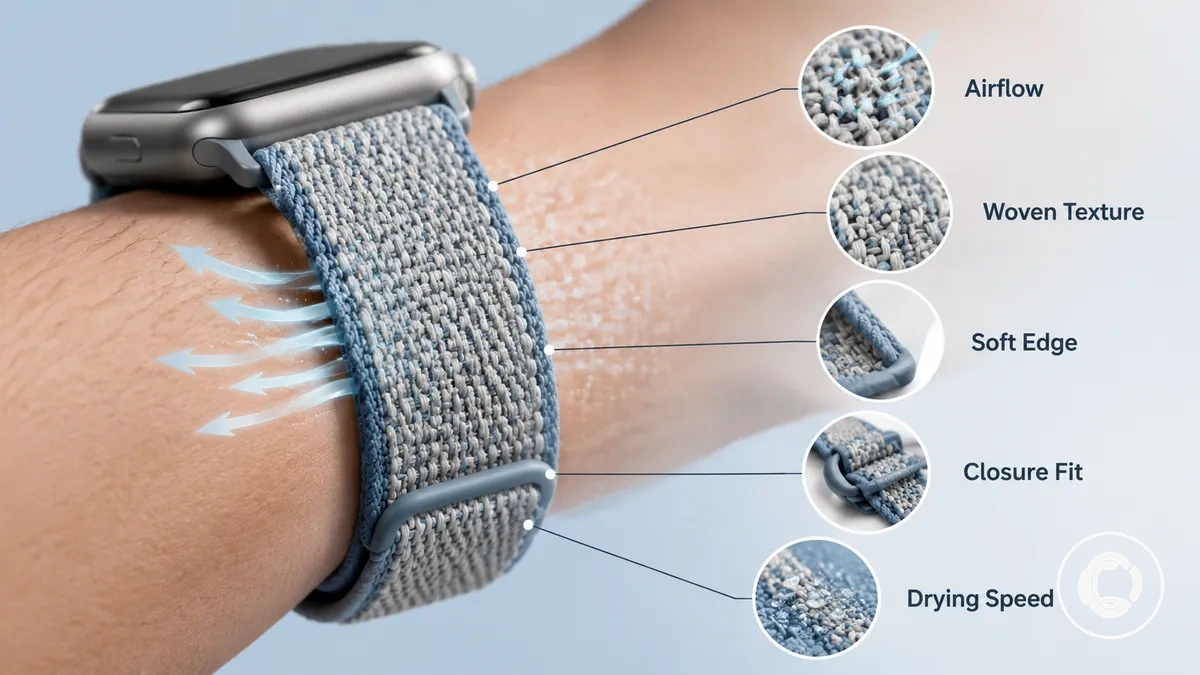
When sweat exposure or overnight wear increases, breathable nylon and woven fabric may help reduce heat buildup around the wrist. However, drying behavior can vary with fabric thickness, weave density, and moisture retention. A woven strap that stays damp for longer periods may still create rubbing discomfort, especially if the strap edge or closure area presses against the same skin contact point.
Breathable nylon and woven fabric bands differ in comfort details that may affect daily wear. These fabric-specific choice signals highlight airflow, softness, and moisture limits.
- Airflow: Open weave designs may improve ventilation around the wrist.
- Strap edge: Softer edge finishing can reduce rubbing risk during movement.
- Drying behavior: Faster drying fabrics may feel more comfortable after sweat exposure.
- Closure style: Better adjustment can help manage wrist pressure and fit changes.
- Moisture retention: Thicker fabric constructions may hold moisture longer than lighter woven options.
Smooth silicone and flexible polymer bands
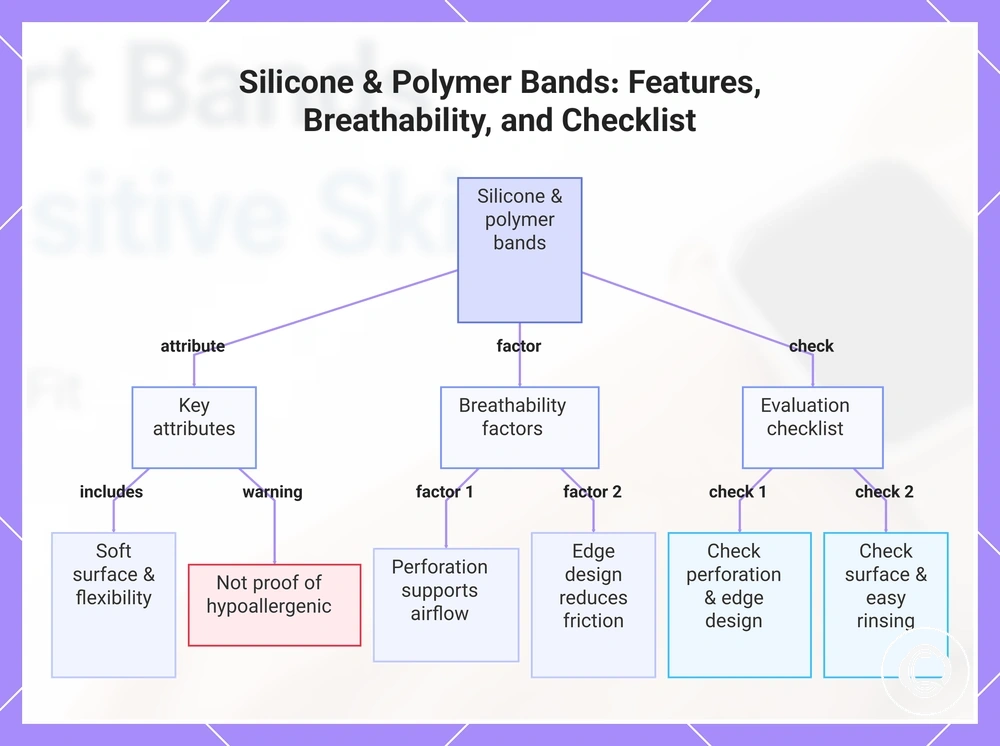
Smooth silicone and flexible polymer bands are smartwatch band options valued for a soft surface, flexibility, and easy rinsing. A silicone strap or polymer band can provide comfortable wrist contact because the material is typically smooth and adapts easily to movement. Breathability, however, often depends on perforation, fit, and band design rather than surface softness alone.
When sweat, residue, or frequent skin contact become concerns, easy rinsing can help keep the contact surface cleaner. Perforation and edge design may improve airflow and reduce friction outcome, while limited ventilation can increase sweat trapping and moisture buildup against the wrist. Softness and flexibility should not be treated as proof of hypoallergenic suitability, because comfort and skin response can vary by material, fit, cleaning habits, and wear conditions.
The checklist below helps separate softness, breathability, and cleaning ease when comparing smooth silicone and flexible polymer bands.
- Check whether perforation supports airflow and helps reduce sweat trapping.
- Look for a smooth soft surface that feels comfortable during wrist movement.
- Review edge design for signs of rubbing risk, pressure points, or friction outcome.
- Consider whether easy rinsing helps remove residue from regular skin contact.
This chart explains the key attributes, breathability factors, and evaluation checklist for smooth silicone and flexible polymer smartwatch bands.
Titanium, ceramic, leather, and coated band considerations
Titanium, ceramic, leather, and coated bands are non-silicone alternatives that can offer different contact surfaces and comfort characteristics for sensitive-skin users. A titanium or ceramic surface may feel smooth against the wrist, while a leather strap or coated band introduces additional factors such as tanning, dye contact, or coating wear. Comfort and sensitivity outcomes often depend on metal hardware, coating quality, leather tanning, and finish quality.
When a wearer has a known allergy or sensitivity, contact points deserve closer attention than marketing labels. Titanium bands may still include metal hardware where nickel exposure can be relevant, ceramic bands depend on surface finish and clasp contact, and leather straps can involve tanning processes or dye contact that affect individual sensitivity. These materials may provide a different comfort experience, but known allergies should guide material avoidance more than product labels because labels do not replace material disclosure.
| Material Type | Contact Factor | Possible Consideration |
|---|---|---|
| Titanium | Metal hardware and clasp contact | Nickel exposure may depend on hardware components and construction |
| Ceramic | Smooth contact surface and finish | Comfort may vary with finish quality and clasp contact |
| Leather | Tanning and dye contact | Sensitivity response can vary by leather treatment and wear conditions |
| Coated Band | Coating wear and surface exposure | Contact characteristics may change if coating wear develops over time |
Fit, adjustability, and wrist pressure
Fit, adjustability, and wrist pressure affect smartwatch band comfort as much as material choice. Band fit influences how pressure is distributed across the wrist, how much movement occurs during wear, and how consistently the band maintains skin and sensor contact. Comfort usually depends on balancing snugness, movement, and sensor contact rather than tightening the band as much as possible.
The checklist below helps evaluate fit, movement, wrist contact, and pressure distribution before deciding whether adjustment changes are needed.
- Check whether hole spacing allows small changes in snugness without forcing a noticeably tighter or looser setting.
- Look for micro-adjustment features if wrist size or comfort changes throughout the day.
- Consider whether strap width distributes wrist pressure evenly across the contact area.
- Review buckle bulk and closure design for pressure points that may create pressure marks.
- Check edge shape for signs of rubbing during movement or extended wear.
- Confirm that strap adjustment maintains sensor contact without excessive wrist pressure.
Adjustment details can change comfort even when the band material stays the same. Wider hole spacing may limit fine-tuning, while micro-adjustment can provide more precise control over snugness. Strap width influences pressure distribution, and buckle bulk can make hardware more noticeable against the wrist. If pressure marks appear regularly, a more adjustable closure or less bulky hardware may be worth considering.
When a band is too tight, wrist pressure, rubbing, and pressure marks may become more noticeable. When a band is too loose, movement can increase and sensor contact may become less consistent. Because wrist size, activity level, and wear conditions vary, the most comfortable fit usually depends on balanced adjustability rather than a universal adjustment rule.
This chart groups the key fit and adjustability checks for smartwatch bands, covering adjustment features, pressure distribution, and movement contact.
Breathability and moisture control during daily wear
Breathability and moisture control during daily wear affect smartwatch band comfort even when the band feels soft against the skin. Moisture, sweat, water exposure, and residue can change how the band interacts with the wrist throughout the day. Daily comfort often depends on airflow, drying speed, and residue retention rather than softness alone.
Office wear, humid weather, handwashing, and overnight use can create different moisture-control conditions. In a climate-controlled office, residue retention may build gradually through daily wear, while humid weather can slow drying speed and increase dampness. Frequent water exposure from handwashing may leave moisture around the contact area, and overnight use can extend skin contact time when airflow is limited. When moisture remains trapped for long periods, rubbing, odor, or skin discomfort may become more noticeable.
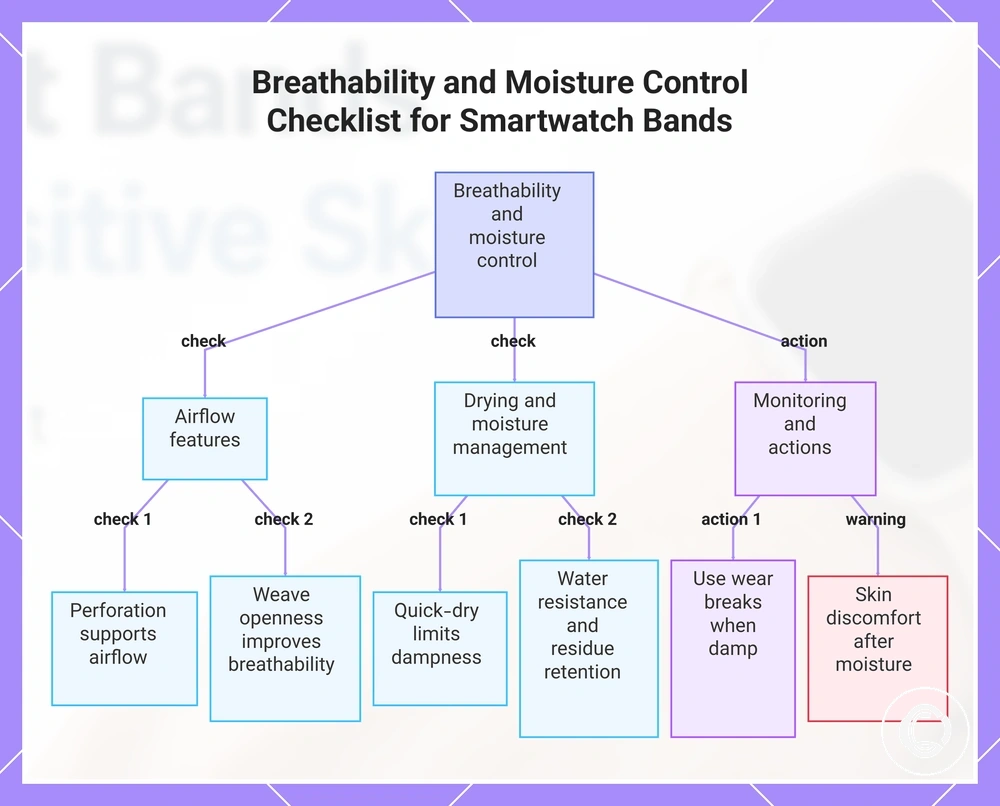
Short wear breaks and routine cleaning habits can support moisture control without turning band care into a maintenance routine. Allowing a smartwatch band to dry after water exposure or sweat may reduce prolonged contact with moisture and residue. The checklist below organizes breathability, airflow, drying speed, and cleaning-related comfort signals.
- Check whether perforation supports airflow around the wrist contact area.
- Look for weave openness or ventilation features that may improve breathability.
- Consider whether quick-dry behavior helps limit prolonged dampness after water exposure.
- Review whether water resistance and residue retention affect comfort during daily wear.
- Use wear breaks when the band remains damp for extended periods.
- Pay attention to recurring rubbing, odor, or skin discomfort after moisture exposure.
This chart organizes the key checks and actions for assessing breathability and moisture control during daily wear of smartwatch bands.
Hypoallergenic claims and allergen checks before buying
Hypoallergenic claims should be treated as screening signals rather than guarantees when evaluating a smartwatch band. A low-allergen claim may help narrow options, but individual reactions can still depend on hardware, coatings, dyes, and other contact materials. A more reliable buying decision starts with clear material disclosure.
The table below organizes allergen checks that can help confirm what a claim actually covers before purchase. These checks focus on disclosure, contact materials, and factors that may reduce uncertainty while acknowledging remaining risk.
| Claim or Spec | What to Check | Why It Matters |
|---|---|---|
| Hypoallergenic Claims | Material disclosure | Helps identify what materials are in direct skin contact |
| Nickel-Free Hardware | Hardware components and clasp details | May reduce uncertainty for users with known metal sensitivity |
| Latex Status | Whether latex content is disclosed | Helps screen for potential latex-related concerns |
| Coating Type | Surface coating information | Coating wear may change long-term skin contact conditions |
| Dye Contact | Dye or finish disclosure | May help evaluate sensitivity screening for known dye reactions |
| Return Flexibility | Available return terms and conditions | Can reduce uncertainty when comfort outcomes are difficult to predict |
| Cleaning Guidance | Care information provided with the band | Helps assess ongoing residue and contact management |
For users with known sensitivity, allergen checks become more important than broad marketing labels. Metal sensitivity may make nickel-free hardware details more relevant, while previous reactions to dye contact can justify closer review of finishes and colour treatments. If a coating type is not clearly disclosed, long-term contact conditions may be harder to evaluate because coating wear can change surface exposure over time. In these situations, return flexibility can support a lower-uncertainty buying decision.
A practical buying check focuses on what is disclosed rather than what is implied by a hypoallergenic band claim. Material disclosure, allergen checks, and clear specifications can improve sensitivity screening, but they do not provide medical certainty.
Choosing a comfortable band by wear context
Choosing a comfortable band depends on wear context rather than material name alone. A smartwatch band that feels suitable in one situation may feel less comfortable in another when skin contact conditions change. The most useful comparison considers wear duration, sweat exposure, adjustment needs, and cleaning frequency.
Daily wear, sleep, light activity, humid conditions, and known sensitivity can each shift which attributes deserve priority. For daily use, balanced softness and adjustability may help maintain comfort throughout changing routines. Sleep wear may benefit from low bulk and stable wrist contact, while light activity can increase the importance of breathability and rinsability. When choosing a comfortable band, humid conditions and known sensitivity often make airflow, cleaning ease, and contact-material awareness more relevant.
A decision matrix can simplify selection by matching skin triggers to band attributes rather than focusing on a single feature. If trapped moisture is a recurring concern, breathability and quick-dry behavior may deserve more attention. If wrist pressure or movement causes discomfort, adjustability and lower bulk may become stronger decision factors. When known sensitivity is involved, material disclosure and contact-surface details can help reduce uncertainty.
| Wear Context | Attributes to Prioritise | Why They May Matter |
|---|---|---|
| Daily Wear | Softness, adjustability | Can support comfort across changing routines |
| Sleep | Low bulk, stable fit | May reduce awareness of wrist contact overnight |
| Light Activity | Breathability, rinsability | Can help manage moisture and residue exposure |
| Humid Conditions | Airflow, quick-dry behavior | May help limit prolonged dampness |
| Known Sensitivity | Material disclosure, contact awareness | Can support a safer purchase decision with lower uncertainty |
The most comfortable choice usually comes from matching attributes to wear conditions rather than searching for a universally suitable band. Different skin triggers can lead to different priorities, which is why context-based selection often supports a safer purchase decision.
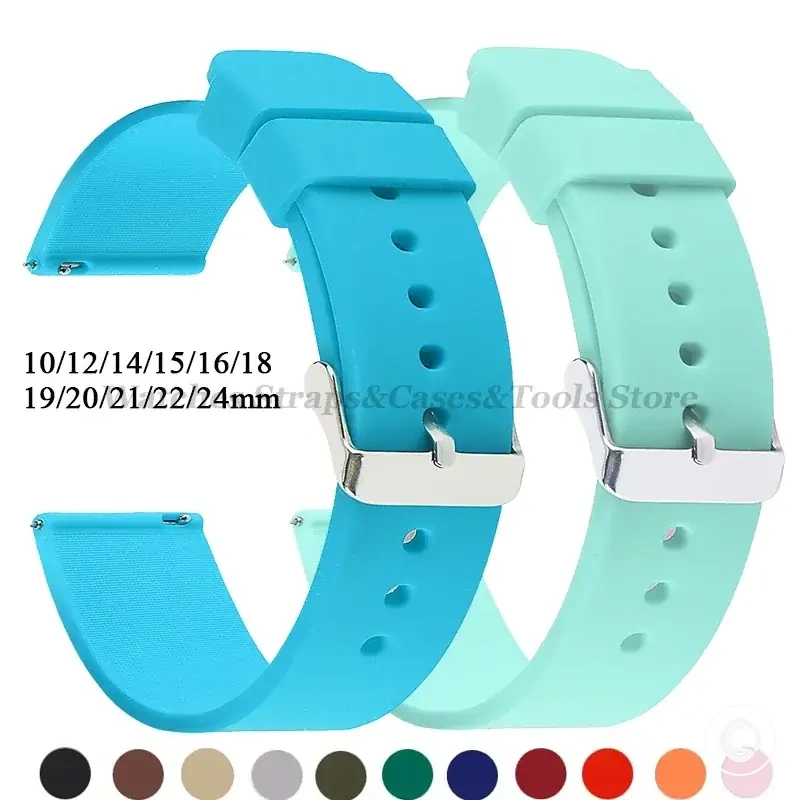
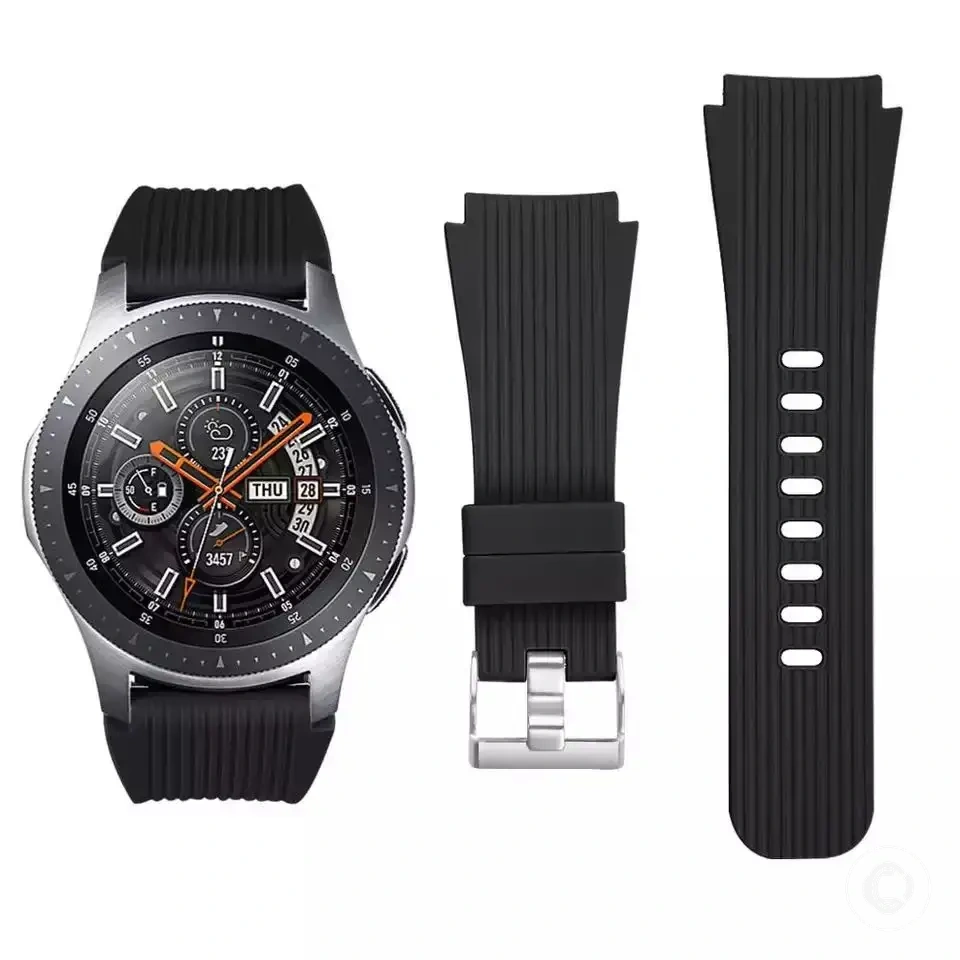
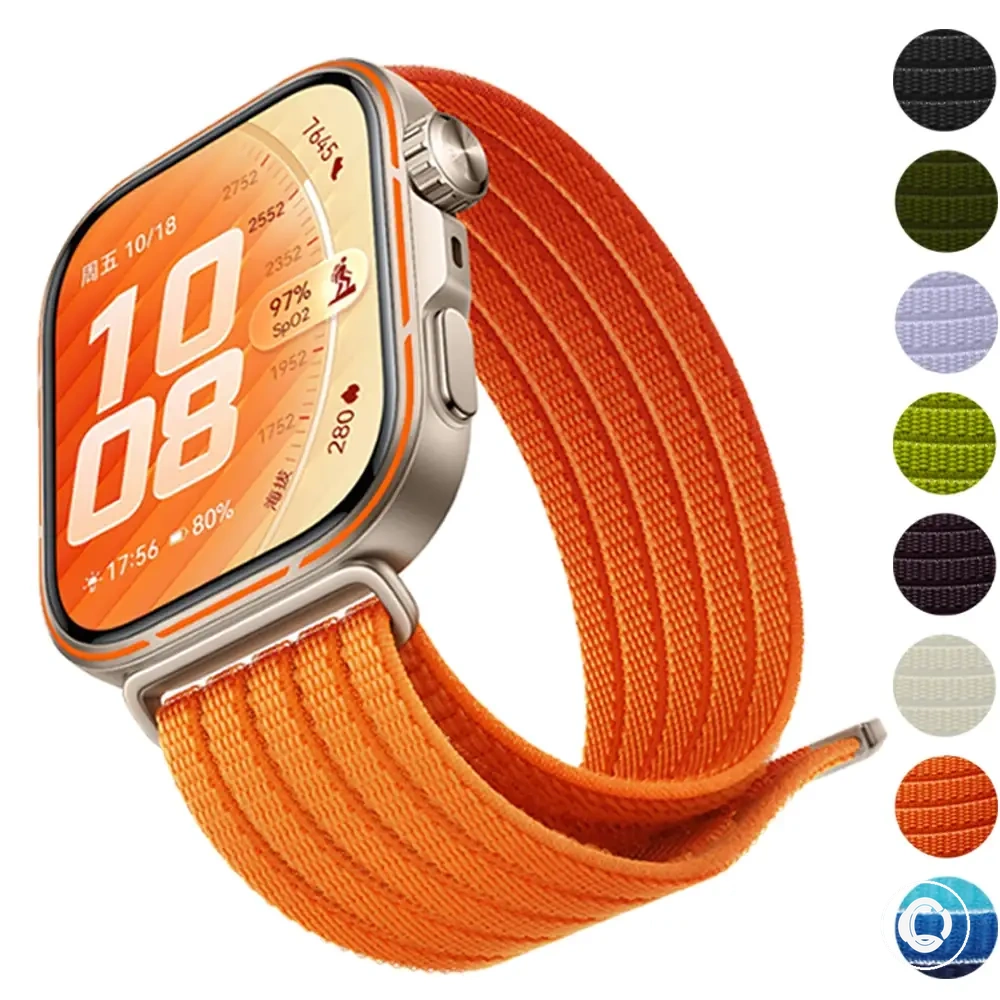
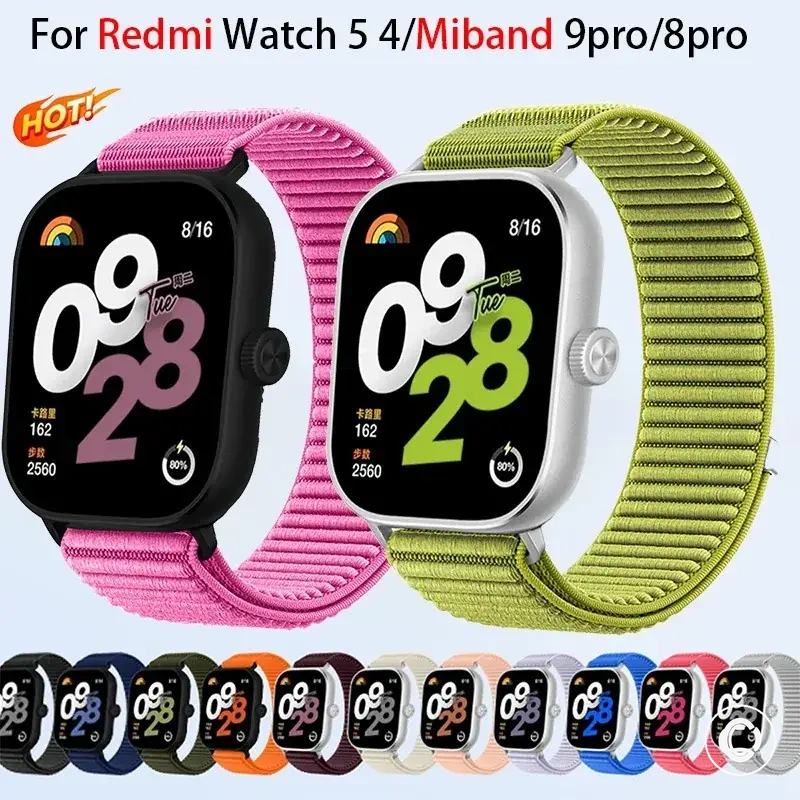
Here are product examples that may make comparison easier. Before buying, always review the compatibility criteria, essential features, and product details.
All-day wear and sleep comfort
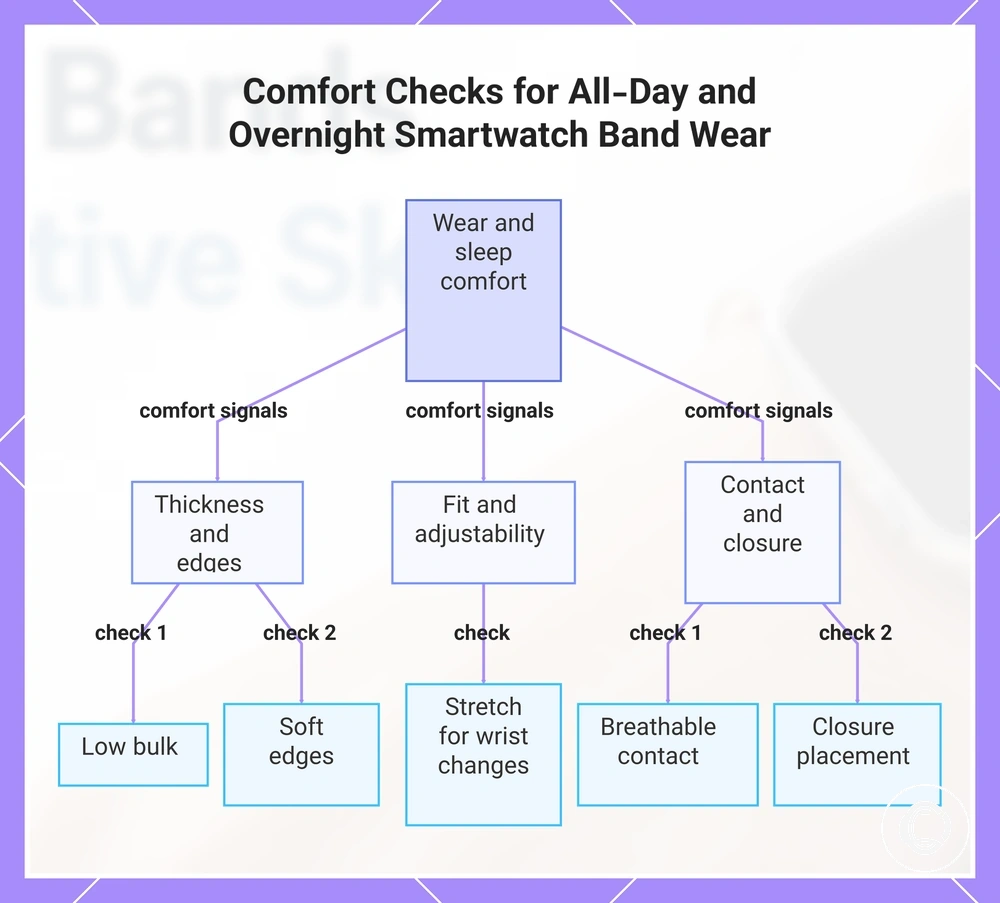
All-day wear and sleep comfort depend on how a smartwatch band feels after long wear or overnight use. Extended wear increases the importance of band thickness, edge finish, clasp position, adjustability, and airflow because small pressure points can become more noticeable over time. A lower-comfort-risk band usually combines low bulk, soft edges, stretch, and breathable contact.
Overnight comfort varies because skin response, wrist swelling, and moisture buildup can change while the band stays in place. A band that feels comfortable during the day may still rub, press, or trap dampness during sleep if closure placement or edge shape concentrates pressure. Use the checks below as comfort signals, not as a sleep-safe guarantee.
- Low bulk: Choose a thinner profile when clasp height or band thickness feels noticeable during long wear.
- Soft edges: Check whether the strap edge feels smooth enough to reduce rubbing risk.
- Stretch: Look for enough flexibility to adapt to small wrist-size changes without excess wrist pressure.
- Breathable contact: Prioritise airflow when moisture buildup is a recurring overnight concern.
- Closure placement: Avoid clasp positions that press into the wrist during rest or extended wear.
This chart shows the key comfort signals to check for extended and sleep wear of a smartwatch band, based on physical and design factors.
Light activity and sweat-prone use
Light activity and sweat-prone use can change how a smartwatch band feels even without intense exercise. Light movement increases wrist contact changes, while moisture can alter surface feel and make airflow more noticeable during wear. As sweat-prone use becomes more frequent, comfort is influenced more by breathability, rinsing need, and drying speed.
Light activity and sweat-prone use:
| Comfort Focus | What May Help |
|---|---|
| Breathability | Breathable fabric may feel more comfortable when trapped moisture is the main concern. |
| Rinsing Need | Rinsable silicone may suit users who prefer easier maintenance after light sweat exposure. |
| Drying Speed | Drying behaviour varies by material and construction, which can influence next-wear comfort. |
Light activity can make slipping, rubbing, and trapped moisture more noticeable as wrist movement increases throughout the day. A band with suitable grip, adequate airflow, and easier maintenance may help reduce discomfort linked to moisture and repeated skin contact. This guidance is limited to light activity and sensitive-skin comfort; higher-intensity training belongs to a workout-specific decision context.
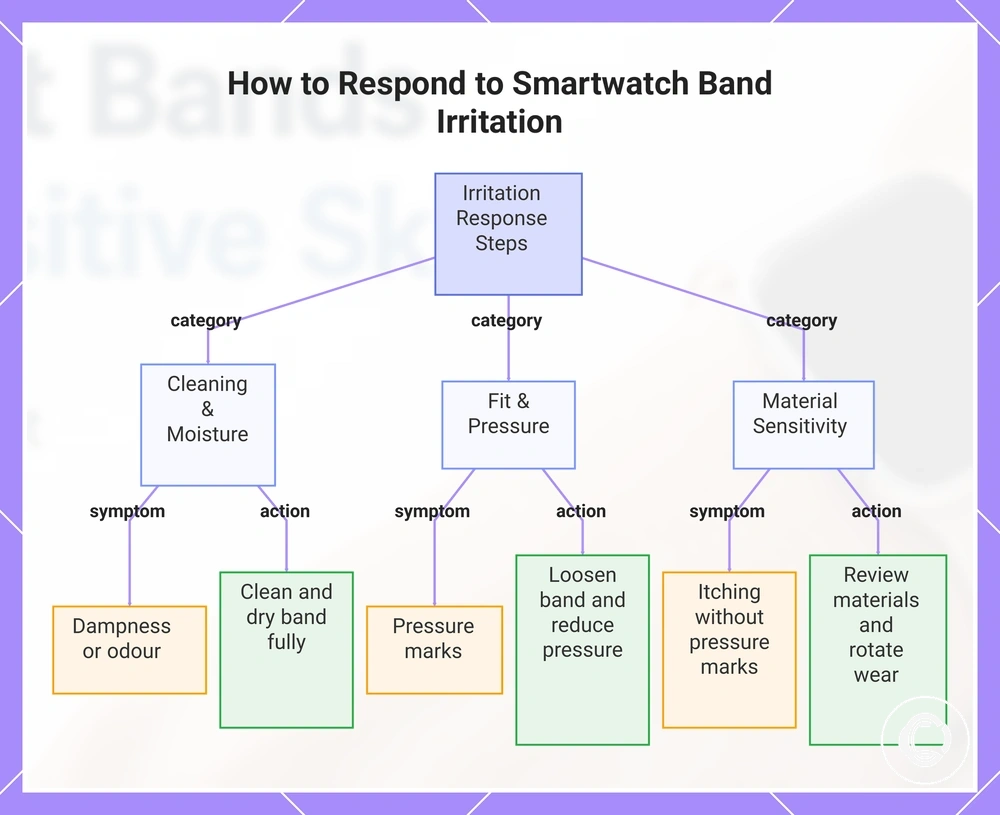
When irritation means cleaning, loosening, or changing materials
When irritation appears, pause wear and check moisture, tightness, residue, and material exposure before continuing. Redness, itching, pressure marks, dampness, or discomfort can have different triggers that require different responses. A simple review of cleaning needs, fit, and material contact can help separate the next step.
Not every irritation signal points to the same cause. Dampness, trapped residue, or infrequent cleaning may call for maintenance, while pressure marks can suggest excessive tightness or prolonged contact. Known sensitivities to certain materials, coatings, or hardware may require a different approach. For a deeper review of possible skin irritation causes, focus on identifying the trigger before changing multiple variables at once.
- Redness after wear → Check moisture, residue, and recent wear duration → Clean and dry the band before wearing again.
- Itching without visible pressure marks → Review material exposure, coatings, or hardware contact → Consider rotating wear or changing materials.
- Dampness or odour → Check trapped moisture and cleaning frequency → Allow the band to dry fully and remove residue.
- Pressure marks → Review fit and closure tension → Loosen the band and reduce prolonged pressure.
- Known allergy concerns → Review disclosed materials and contact points → Avoid continued exposure to suspected triggers.
Many comfort issues may improve when moisture, residue, or excessive pressure are reduced. Consistent cleaning to reduce irritation may help when buildup contributes to discomfort, while fit adjustments can reduce rubbing and pressure concentration. Material changes are usually most relevant when irritation continues despite cleaning and fit checks.
If symptoms persist, worsen, become painful, or continue after cleaning, drying, loosening, or changing materials, professional advice may be appropriate. A more focused irritation review can help distinguish smartwatch-band contact issues from other skin concerns without relying on self-diagnosis.
This chart guides you through identifying the likely cause of band irritation and the recommended action based on cleaning, fit, and material checks.