
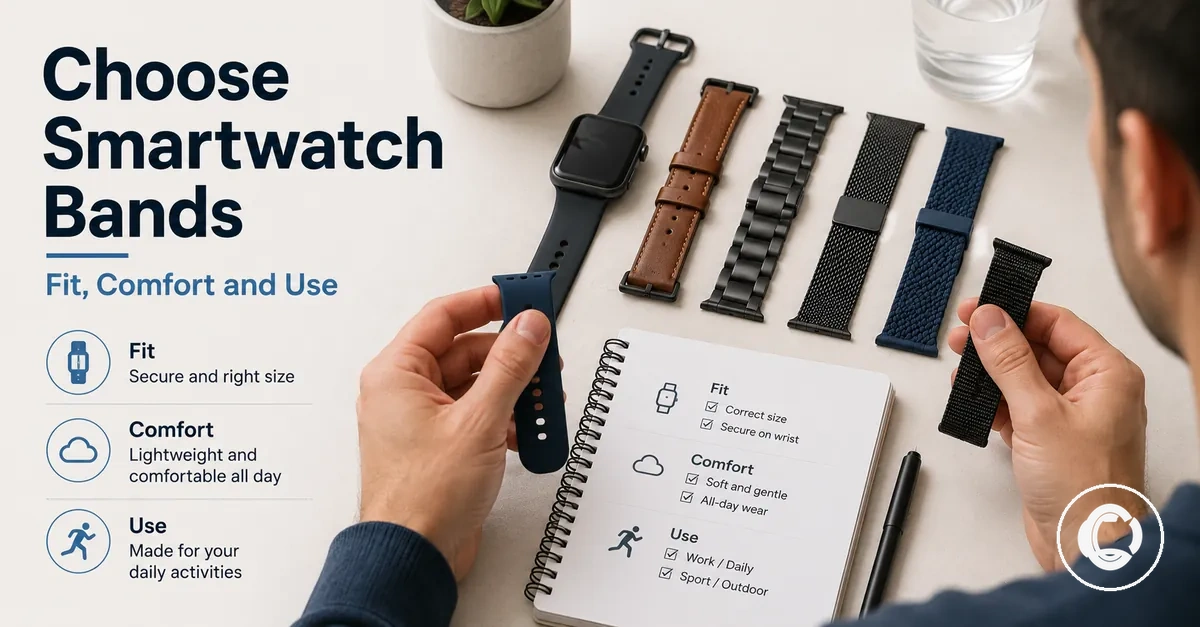
Smartwatch Band Selection Checklist
A suitable smartwatch band should match your watch, wrist, comfort need, material tolerance, and use condition before value is considered. The selection checklist separates must-match factors from preference factors. Fit is the first gate.
A smartwatch band is a replaceable watch strap that changes how the watch fits, feels, and handles daily wear. The right band choice depends on the watch model, connector, wrist size, material, and expected use. This page uses smartwatch bands as decision items, not as brand-specific products or fixed matches. Compatibility and comfort can vary by device and wearer.
If a band looks suitable but the connector, band length, or adjustment range is wrong, the choice may fail early. If fit and compatibility are clear, comfort, material, daily wear needs, and value become easier to judge. Use this buying checklist as a pass, caution, or keep-comparing route.
Fit and Compatibility Checks for Smartwatch Bands
A smartwatch band may be compatible when the watch model, case size, connector, and wrist fit can work together. A matching look does not confirm a matching fit. Check the physical connection before judging comfort, material, or value.
The watch model and case size shape the first compatibility check because the band must attach to the watch body in the correct way. The connector type then decides whether the strap end can lock in, slide in, or may need an adapter. The Fit and Compatibility Checks for Smartwatch Bands image can help clarify the watch case, connector area, lug width reference, and wrist-fit points before the checklist.
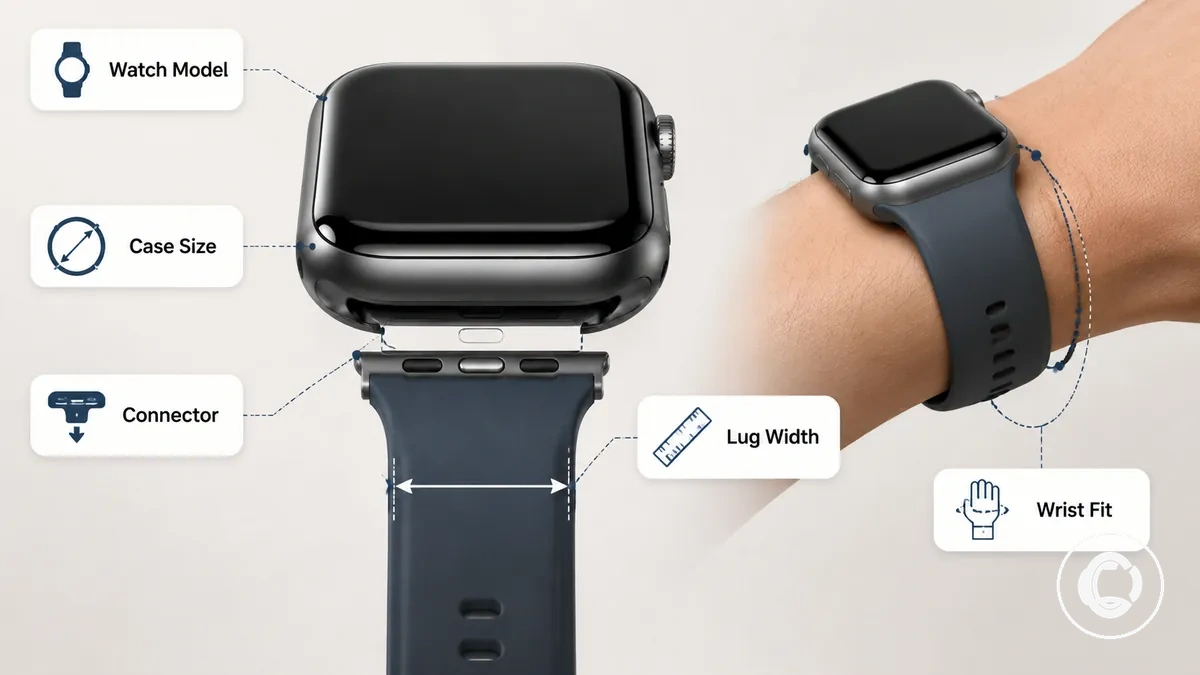
If the connector matches but the band length or adjustment range does not suit the wrist, the result may be a caution rather than a pass. If the connector or lug width is unclear, check compatibility before comparing comfort signals. Use this mini-checklist to verify the main physical fit conditions before moving to comfort, material, or value.
- Check the watch model: pass when the band is made for the same watch-side connection; use caution when the model family is similar but not confirmed.
- Check the case size: pass when the band is listed for the same case range; reject or keep comparing when the case size may change the connector position.
- Check the connector type: pass when the strap end matches the watch connector; use caution when an adapter is required.
- Check the lug width: pass when the strap size and lug width align; use caution when the same width does not confirm the connector fit.
- Check the band length: pass when the strap can sit around the wrist without excess pull or loose overhang; keep comparing when length limits the wrist fit.
- Check the adjustment range: pass when holes, clasp range, or stretch allow a secure fit; use caution when the wrist falls between adjustment points.
Watch Model, Case Size, and Connector Type
Compatibility depends on checking the watch model, case size, and connector type together before treating a band as a match. A watch model may require a specific connector or adapter. A compatible result often needs confirmation from all three watch-side factors.
A watch model can determine which connector type matches the watch body, while case size can affect how the band end aligns with the lug area. When connector type differs, an adapter may be required before compatibility can be confirmed. For example, the same band width may appear to fit a lug measurement, but a different connector type can still prevent connector fit.
The image highlights Watch Model, Case Size, and Connector Type and shows the parts that should be checked together. The labels identify the watch case, connector slot or lug area, band end, and size reference.
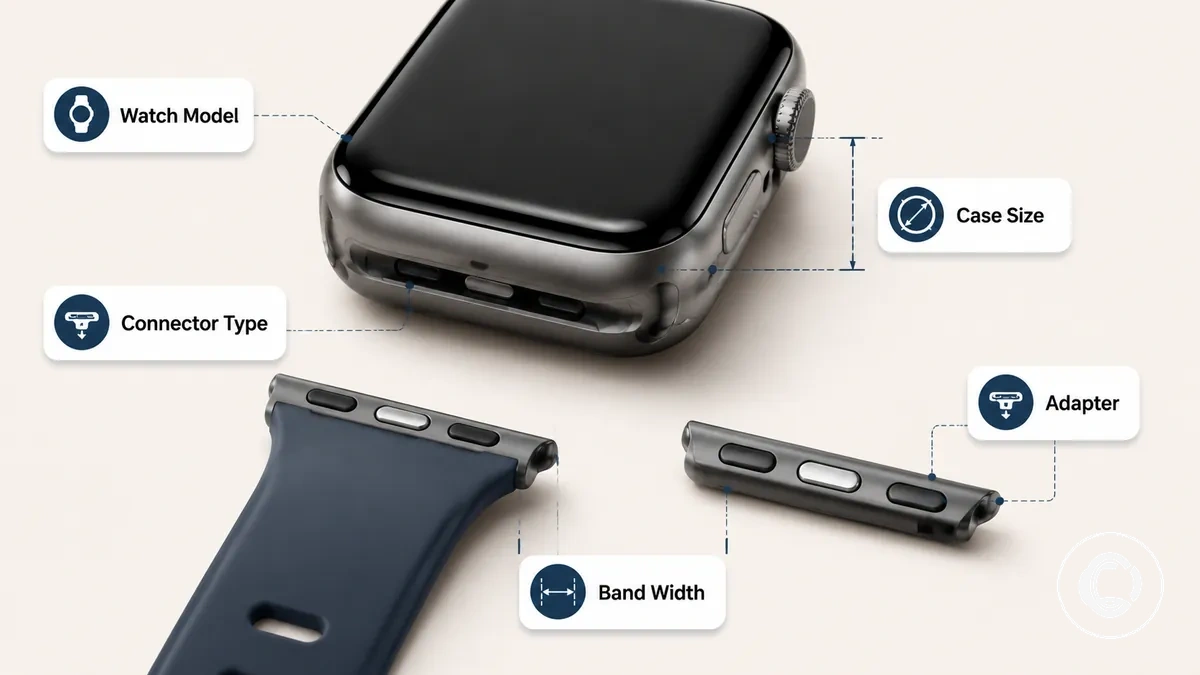
These Watch Model, Case Size, and Connector Type checks help confirm whether a band appears compatible, incompatible, or requires confirmation.
- Watch model: Compatible when the band is intended for the same watch-side connection; requires confirmation when model details are unclear.
- Case size: Compatible when the case size matches the intended band range; incompatible when case measurement changes band alignment.
- Connector type: Compatible when the strap connector matches the watch connector; incompatible when the connection systems differ.
- Adapter requirement: Requires confirmation when an adapter is needed to connect the band end to the watch.
- Band width and lug: Requires confirmation when the same width is present but connector type differs, because width alone may not confirm fit.
Wrist Size, Band Length, and Adjustment Range
If wrist size, band length, and adjustment range work together, the band may tighten, loosen, and sit correctly on the wrist. A secure fit depends on more than wrist measurement alone. Band design and adjustability can change the result.
A small wrist may leave excess strap length, while a large wrist may approach the end of the adjustment range. A wrist that falls between holes may make tightness harder to fine-tune. In either situation, fit may require closer review before the band feels stable.
Adjustment range helps determine how much the band can tighten or loosen after it is worn. Hole spacing, clasp range, and stretch allowance can influence whether the band feels loose or may create pressure risk.
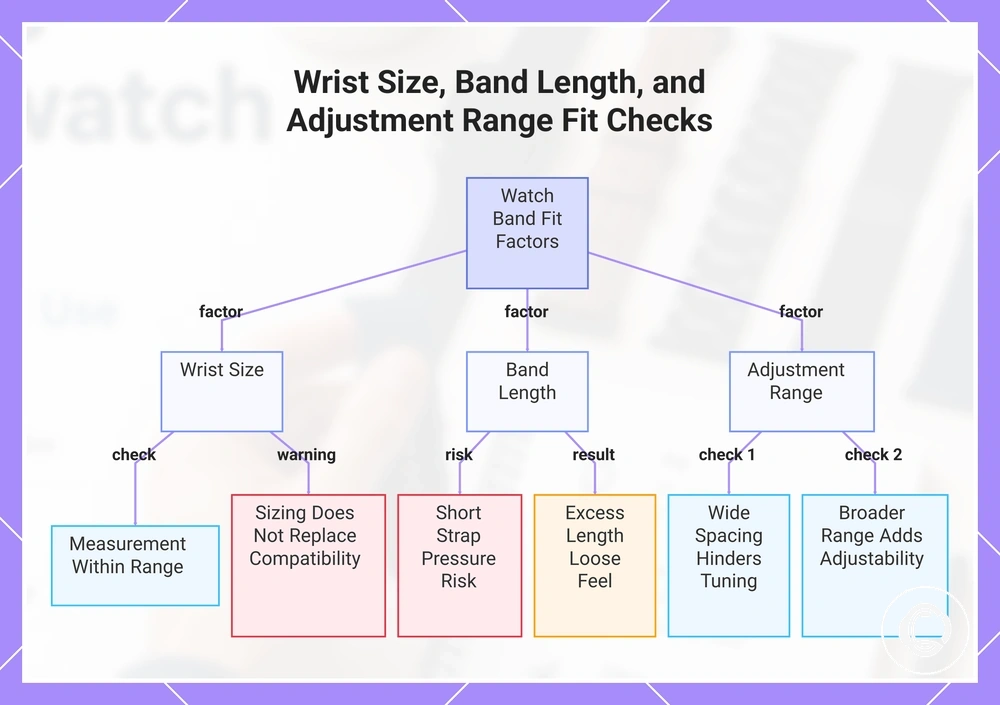
Wrist size can affect comfort and sensor stability, but sizing does not replace compatibility checks. For deeper sizing guidance, measure band size. Use the checklist below to verify Wrist Size, Band Length, and Adjustment Range fit conditions.
These Wrist Size, Band Length, and Adjustment Range checks help verify whether the band can adjust appropriately for the wrist.
- Wrist size: A wrist measurement that falls within the adjustment range may support a more stable fit.
- Band length: A strap length that is too short may increase pressure risk, while excess length may lead to a looser feel.
- Hole spacing: Wide hole spacing may make tightness harder to adjust when the wrist sits between holes.
- Clasp range: A broader clasp range can provide additional adjustability for different wrist sizes.
- Stretch allowance: An elastic band with stretch allowance may support movement while helping maintain a secure fit.
This chart shows the three main factors and their specific checks to verify whether a watch band can adjust appropriately for a given wrist.
Comfort Signals for Daily Wear
During daily wear, comfort often becomes clearer after several hours of use rather than during the first few minutes. A band that feels comfortable at rest may feel different during movement. Repeated wear can reveal whether the band remains comfortable throughout the day.
Weight, edge finish, clasp pressure, and sweat behavior can influence wear comfort in different ways. A lightweight band with a smooth edge finish may reduce noticeable contact points, while uneven edges or concentrated clasp pressure may create adjustment needs. Breathability and sweat behavior can affect skin feel during activity, which may influence comfort and irritation risk over time.
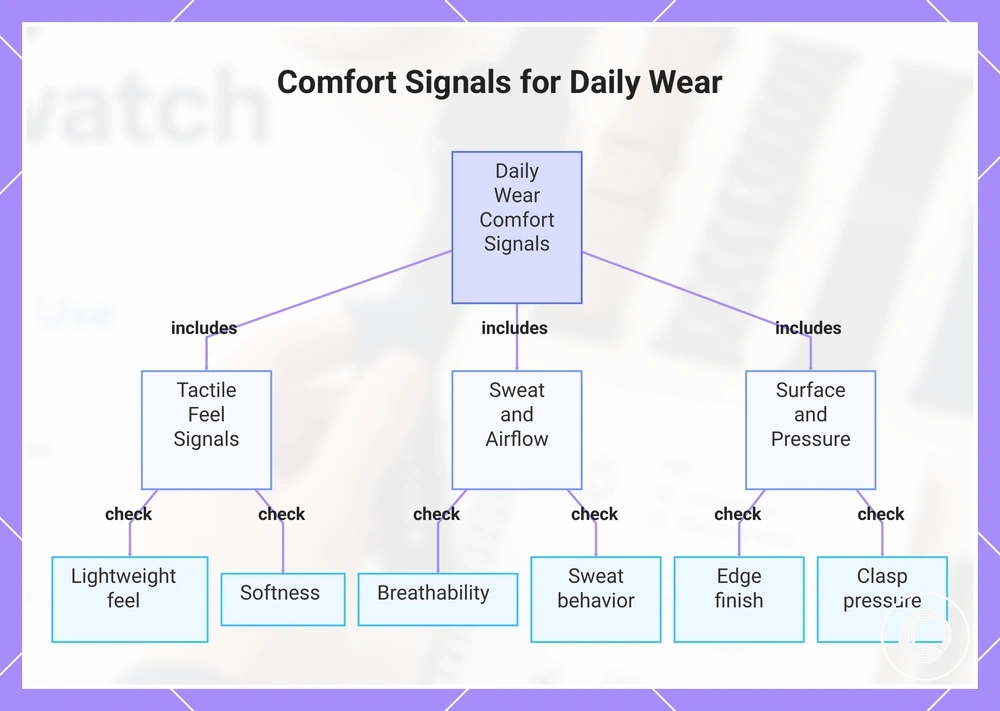
A comfortable band is usually identified through a combination of softness, breathability, weight, and pressure distribution rather than a single feature. Comfort at rest and comfort during movement can differ, so both situations are worth evaluating. The Comfort Signals for Daily Wear checklist below highlights the signals that can help guide a selection decision.
These Comfort Signals for Daily Wear checks help identify observable comfort cues during repeated use.
- Lightweight feel: Lower weight may reduce wrist awareness during extended daily wear.
- Softness: A softer contact surface may improve skin feel during regular use.
- Breathability: Better airflow can help manage sweat behavior and reduce the need for frequent adjustment.
- Edge finish: Smooth edges may feel less noticeable against the wrist during movement.
- Clasp pressure: Concentrated pressure around the clasp area may indicate that adjustment is needed.
- Sweat behavior: Moisture buildup may affect comfort and influence long-term wear preferences.
This chart groups the observable comfort signals that help evaluate a band's daily wear comfort into three categories: tactile feel, sweat and airflow, and surface and pressure.
Lightweight Feel and Breathability
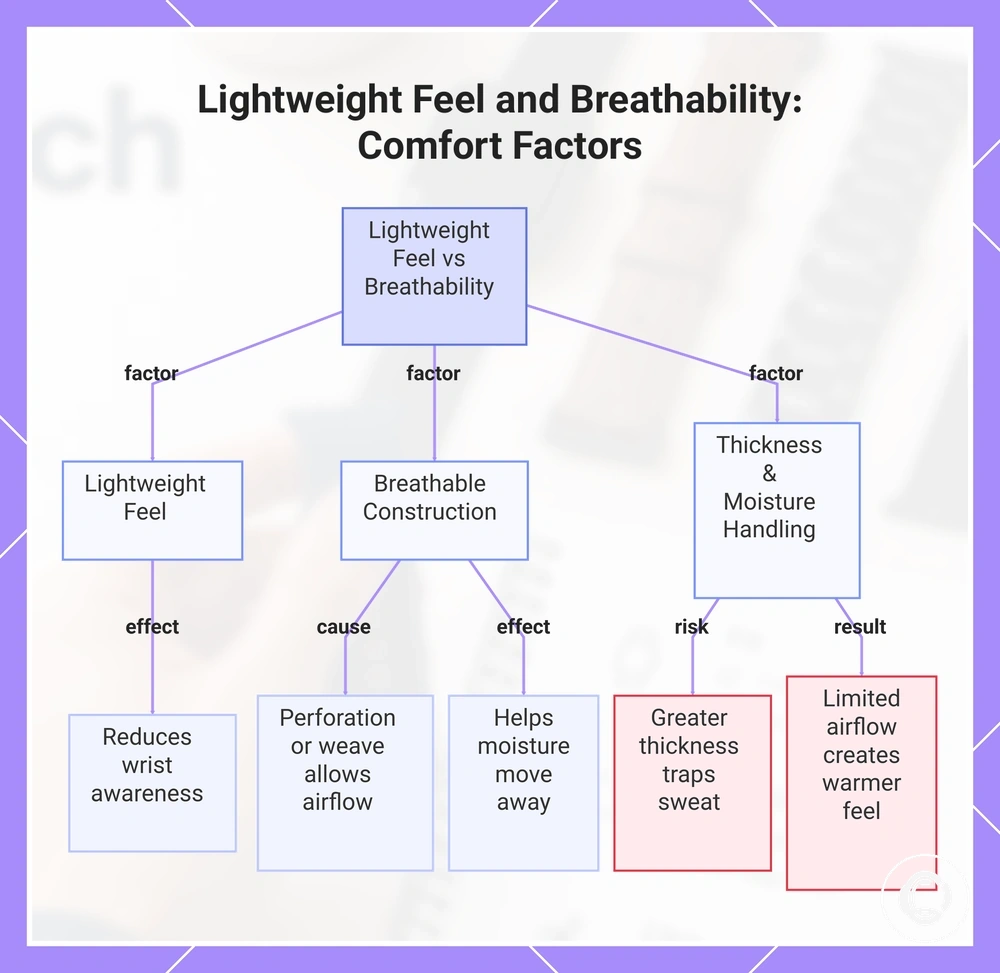
Lightweight feel and breathability affect daily comfort in different ways. Lower weight can reduce wrist awareness during wear. Airflow can influence moisture handling and how the band feels over longer periods.
During normal wear, a band may feel more comfortable because its weight, thickness, and design create a lighter feel. During sweat exposure, airflow, perforation, weave, and moisture handling can become more noticeable because trapped sweat may affect comfort. For example, an open weave may allow more airflow than a denser construction, but comfort still depends on fit, movement, and wear conditions.
Lightweight Feel and Breathability compare how weight and airflow influence comfort perception during daily wear.
- Lightweight feel: Lower weight can make the band feel less noticeable and reduce wrist awareness.
- Breathable construction: Airflow from perforation or weave may help moisture move away from the skin surface and contribute to a cooler feel.
- Thickness and moisture handling: Greater thickness or limited airflow can increase the chance of trapped sweat and may create a warmer feel during extended wear.
This chart shows how lightweight feel and breathability influence comfort during daily wear, including the effects of weight, airflow, and thickness.
Secure Fit Without Pinching or Sliding
A secure fit depends on whether the band stays in place without creating pinching or unnecessary movement. The band should feel stable during normal wear. Tightness, buckle position, and stretch can influence the fit outcome.
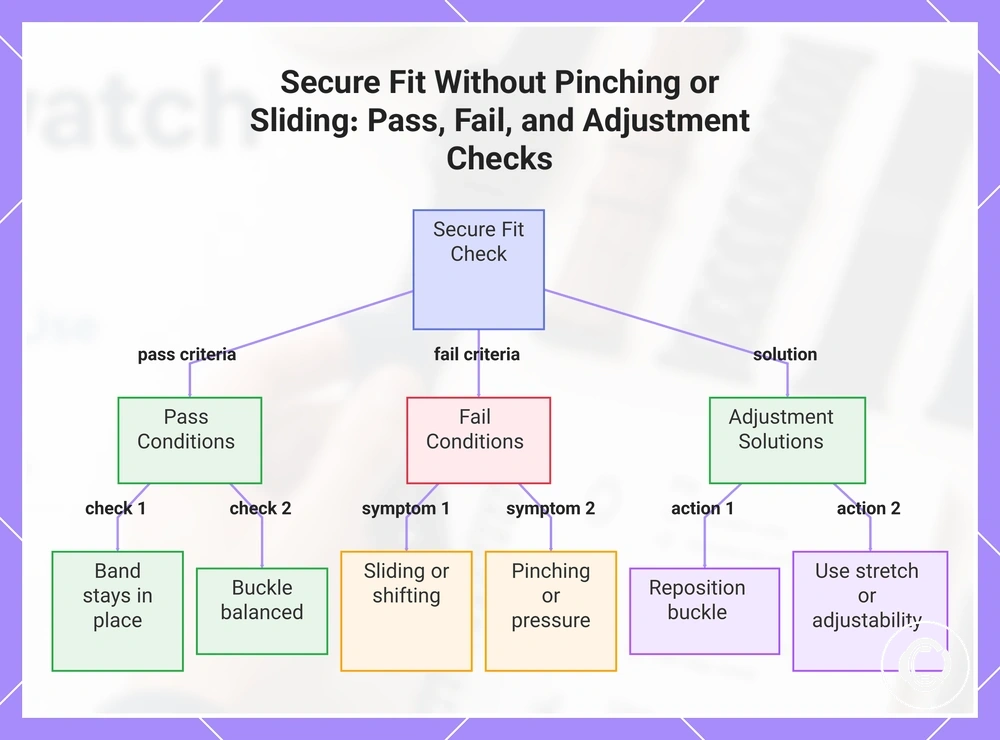
When sliding or sensor movement is noticeable, adjustability may matter more than material preference because small fit changes can affect wrist contact. A loose fit may allow more movement, while excessive tightness may create a pressure point or pinching sensation. Repositioning the buckle or using available stretch and adjustability can help refine the fit between too loose and too tight.
Secure Fit Without Pinching or Sliding checks help diagnose whether wrist fit appears stable, too loose, or too tight during wear.
- Pass: The band stays in place during normal movement and maintains consistent sensor contact with minimal sliding.
- Pass: Buckle position feels balanced and does not create a noticeable pressure point.
- Fail: The band slides around the wrist or shifts position frequently during routine movement.
- Fail: Tightness creates pinching or concentrated pressure that may indicate adjustment is needed.
- Fail: Limited stretch or adjustability makes it difficult to achieve a stable fit between loose and tight settings.
This chart shows the pass and fail conditions for a secure wristband fit, along with adjustment solutions to prevent pinching or sliding.
Material Trade-Offs That Affect Selection
Material trade-offs matter when smartwatch band selection depends on comfort, sweat handling, care, durability, and style fit. Material choice depends on use conditions and personal tolerance. The most suitable option can vary by daily wear habits and appearance preferences.
Silicone, nylon, leather, metal, and mesh differ in material behavior rather than offering a universal advantage. Sweat exposure, cleaning expectations, skin feel, and appearance can influence which trade-off feels acceptable. A material that suits one use case may be less suitable when water exposure, care requirements, or dress expectations change.
If daily wear involves frequent sweat exposure, dress occasions, or specific care preferences, compare the material trade-offs before focusing on appearance alone. For a deeper comparison of material behavior, compare materials. The Material Trade-Offs That Affect Selection table below compares comfort feel, sweat and water exposure, care need, and better-fit conditions.
| Material | Comfort feel | Sweat and water exposure | Care need | Better fit when |
|---|---|---|---|---|
| Silicone | Often soft and flexible. | May handle sweat and water exposure well. | Usually simple to clean. | Sweat handling and low-maintenance care are priorities. |
| Nylon | Often lightweight with good breathability. | May help with moisture movement during daily wear. | Can require regular cleaning after extended use. | Airflow and lighter wrist feel matter most. |
| Leather | Can provide a softer, traditional feel. | May be less suitable for frequent sweat or water exposure. | Often benefits from more careful care. | Style fit and dress use are higher priorities. |
| Metal | Structured feel that may vary with weight and finish. | Can tolerate occasional moisture, depending on conditions. | May need cleaning around links or clasp areas. | A more formal appearance and durable feel are preferred. |
| Mesh | Often flexible with an airy feel. | Open construction may support airflow. | May require cleaning between fine openings. | Breathability and a refined appearance are both important. |
Silicone, Nylon, Leather, and Metal Use Cases
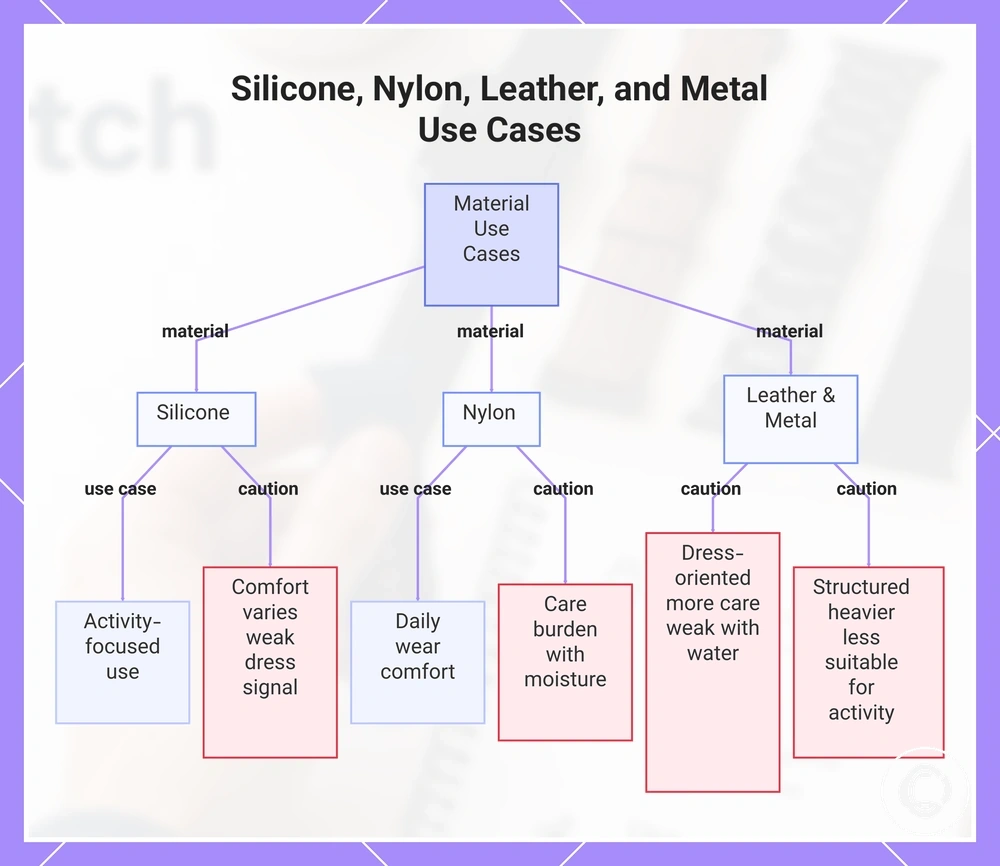
Silicone, nylon, leather, and metal use cases depend on activity fit, comfort feel, water tolerance, and care burden. If a material matches the intended activity and wear conditions, the trade-off may be easier to accept. Each material group usually connects to a different use case and style signal.
For example, exercise, daily wear, office use, and dress occasions can create different material priorities. Silicone, Nylon, Leather, and Metal Use Cases become easier to compare when the focus stays on activity fit, comfort feel, water tolerance, and care burden rather than material preference alone. The comparison block below highlights the likely use case, main trade-off, and caution for each material.
- Silicone: Often suits activity-focused use cases where sweat exposure and water tolerance matter. Main trade-off: comfort feel may vary by fit and surface finish. Caution: may be a weaker match when a stronger dress-style signal is preferred.
- Nylon: Often suits daily wear when breathable, lightweight comfort is important. Main trade-off: care burden may increase with regular moisture exposure. Caution: may need more frequent cleaning in active conditions.
- Leather: Often suits dress-oriented use cases where style signal matters more than water tolerance. Main trade-off: usually needs more care. Caution: may be a weaker match when frequent sweat or water exposure is expected.
- Metal: Often suits settings where a durable feel and structured finish are preferred. Main trade-off: weight may feel more noticeable during longer wear. Caution: may be less suitable for activity-focused use cases when a lighter feel is preferred.
This chart compares the use cases and key considerations for silicone, nylon, leather, and metal materials.
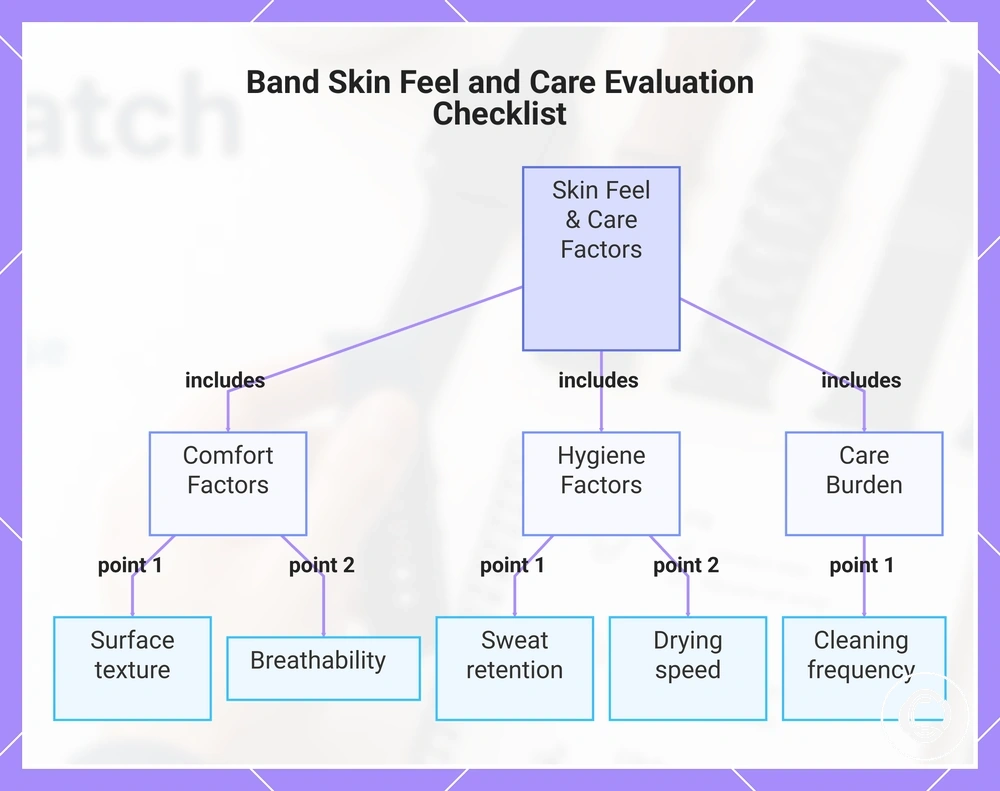
Skin Feel, Sweat Exposure, and Care Needs
During daily wear or exercise, skin feel can change when sweat exposure increases and moisture remains against the wrist. Surface texture and breathability can affect comfort support under these conditions. Material suitability may vary as skin-contact feel changes throughout the day.
When moisture buildup becomes noticeable, sweat retention, drying speed, and cleaning frequency often become more important selection factors. A band with slower drying speed may require more attention to care needs, while better breathability may help reduce odor risk. If discomfort occurs, the cause may relate to fit, hygiene, or material rather than a single factor alone.
Skin Feel, Sweat Exposure, and Care Needs can be evaluated with this mini-checklist:
- Surface texture: A smoother texture may support comfort, while a rougher surface feel can become more noticeable during extended wear.
- Breathability: Better airflow may help limit moisture buildup during sweat exposure and support comfort.
- Sweat retention: Higher sweat retention may increase odor risk and affect long-term wear satisfaction.
- Drying speed: Faster drying speed may reduce the time moisture remains against the skin-contact area and may lower irritation risk.
- Cleaning frequency: Greater cleaning frequency may increase care burden, especially when sweat exposure is common.
This chart shows the key factors to evaluate skin feel, sweat exposure, and care needs for watch bands, based on a mini-checklist.
Matching Band Features to Use Conditions
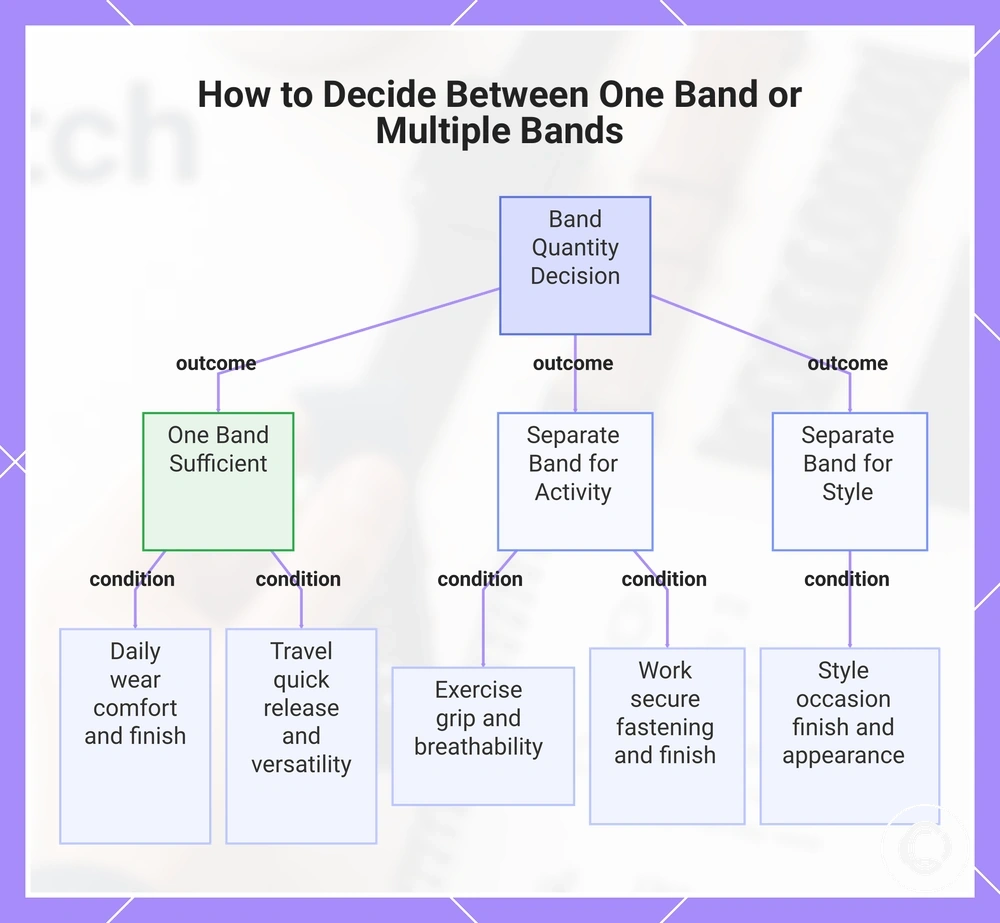
A use condition changes which band features deserve priority during selection. Daily wear, exercise, work, travel, and style occasion needs can shift the importance of comfort, visibility, and adjustment. The most suitable feature match depends on how and where the band will be worn.
When activity level increases, grip and breathability may become more important because sweat exposure can affect comfort and stability. When the watch is worn in visible professional settings, finish and fastening style may influence the feature match more than exercise-focused traits. When bands are changed frequently, quick release designs may support easier transitions between wear situations.
One versatile band may be enough when most use conditions remain similar and feature priorities rarely change. Separate bands may be more suitable when exercise, work, travel, and style occasion requirements call for different feature combinations. The decision depends on how often the use case changes and whether one feature set can support those situations.
For broader scenario-based selection paths, see bands by need. Matching Band Features to Use Conditions becomes easier when the scenarios below organize features around realistic wear situations rather than material alone.
- Daily wear: Prioritize adjustability, comfort, and a balanced finish. Decision cue: one versatile band may be enough when routines stay consistent.
- Exercise: Prioritize grip and breathability when sweat exposure increases. Decision cue: a separate band may be useful if activity demands differ from everyday wear.
- Work: Prioritize secure fastening and an appropriate finish for visible settings. Decision cue: feature priorities may shift when presentation matters more than activity support.
- Travel: Prioritize quick release and versatility when wear situations change frequently. Decision cue: one adaptable band may reduce the need for frequent swaps.
- Style occasion: Prioritize finish and overall appearance when the watch is part of the intended look. Decision cue: a dedicated option may be suitable when style expectations differ from regular use.
This chart shows the use conditions that determine whether a single versatile band is sufficient or separate bands are needed for different scenarios.
Daily Wear, Exercise, and Occasional Style
Daily wear, exercise, and occasional style each change comfort and durability priorities. Daily wear often prioritizes comfort, weight, and adjustability during all-day wear. Exercise can increase movement level and sweat exposure, while occasional style may place greater emphasis on visibility, fastening need, and material tolerance.
One band may not cover all conditions equally well when movement level, sweat exposure, visibility, and fastening need vary across use cases. For example, a band that feels acceptable for daily wear may be weaker for exercise if higher sweat exposure creates a need for more grip and a more secure fit. Daily Wear, Exercise, and Occasional Style can be compared through the use-condition priorities below.
| Use condition | Priority features | Main caution |
|---|---|---|
| Daily wear | Comfort, adjustability, balanced weight, and a versatile feature set | May be weaker when movement level or visibility requirements change significantly |
| Exercise | Grip, secure fit, breathability, and support for higher sweat exposure | Feature priorities may differ from those needed for all-day wear or style occasions |
| Occasional style | Finish, visibility, fastening need, and material tolerance suited to dress use | Style-focused priorities may be weaker for active use conditions |
Fastening, Quick Release, and Ease of Change
Quick release can improve ease of change after fit and compatibility are confirmed. Fastening still affects how the band adjusts on the wrist. A quick-release pin does not guarantee that the connector mechanism or adapter need will match the watch.
Different fastening systems change convenience in different ways without changing the basic compatibility requirement. A buckle, loop, clasp, or magnetic closure can affect adjustment and fit security, while a quick-release pin can make a band swap easier when the connector is already suitable. If an adapter is required, ease of change becomes a secondary factor that still needs confirmation.
Fastening, Quick Release, and Ease of Change checks help compare convenience without turning band changes into an installation tutorial.
- Buckle: Supports familiar adjustment, but hole spacing may limit fine fit changes.
- Loop: Can help manage loose strap length, but the loop position may affect comfort during wear.
- Clasp: May make fastening quicker once adjusted, but fit depends on clasp range and wrist position.
- Magnetic closure: Can feel easy to adjust, but movement may require closer fit-security confirmation.
- Quick-release pin: May make swapping easier when the connector matches, but it does not confirm universal compatibility.
- Adapter: May be needed for some connector systems, so compatibility should be confirmed before valuing ease of change.
Durability and Value Checks Before Buying
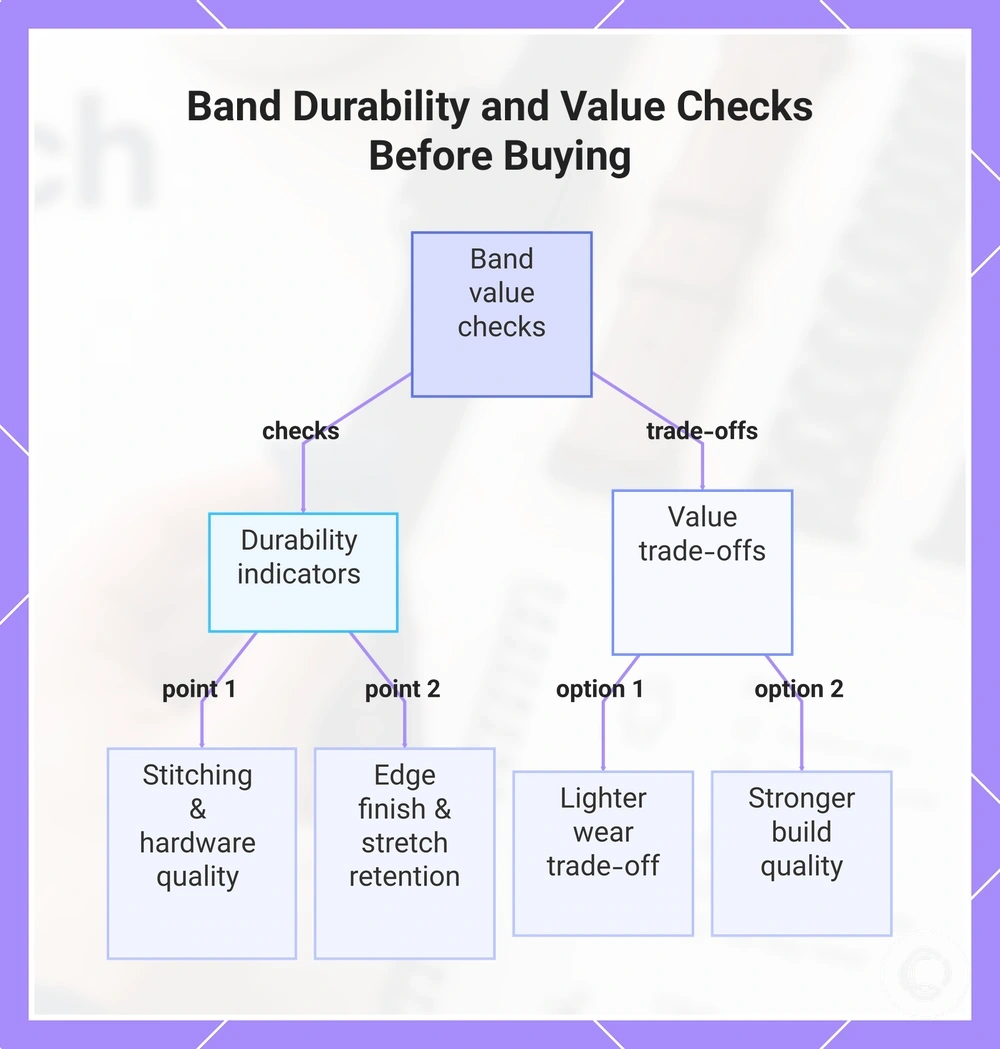
A band offers stronger value when its durability matches the intended wear pattern and replacement frequency. Value depends on more than appearance or material alone. Construction quality and care burden can influence long-term use.
Durability concerns often appear when wear conditions expose weak construction points. Stitching, clasp hardware, connector stability, edge finish, and stretch retention can indicate how a band may handle repeated use. Water exposure and care burden can also affect whether a band remains an acceptable compromise or becomes a poor value risk over time.
Affordable and premium options can both provide acceptable value when their construction matches the intended use condition. An affordable band may offer a reasonable trade-off for lighter wear, while a premium option may justify its position through stronger build quality, lower replacement frequency, or clearer durability signals. For a broader comparison of criteria, see band value and quality.
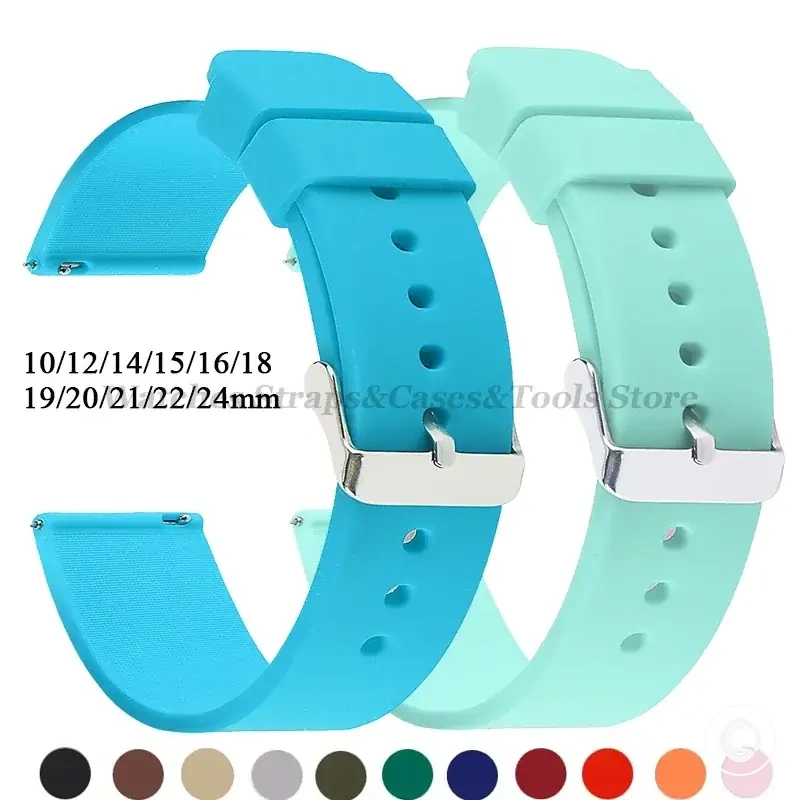
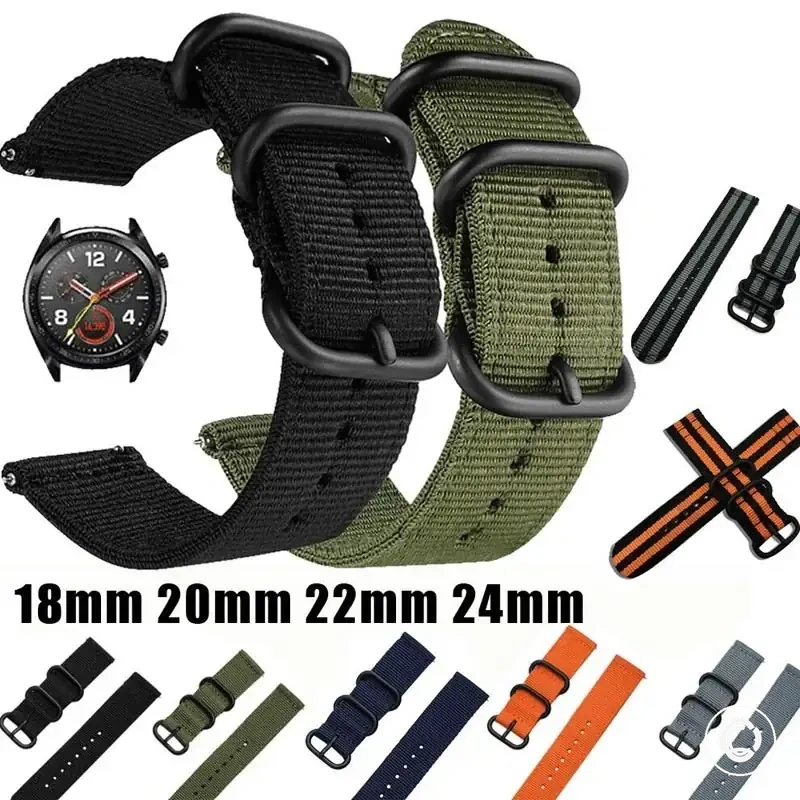
The products below are useful examples for comparing available options. Before buying, check that the compatibility criteria, key features, and product details match your needs.
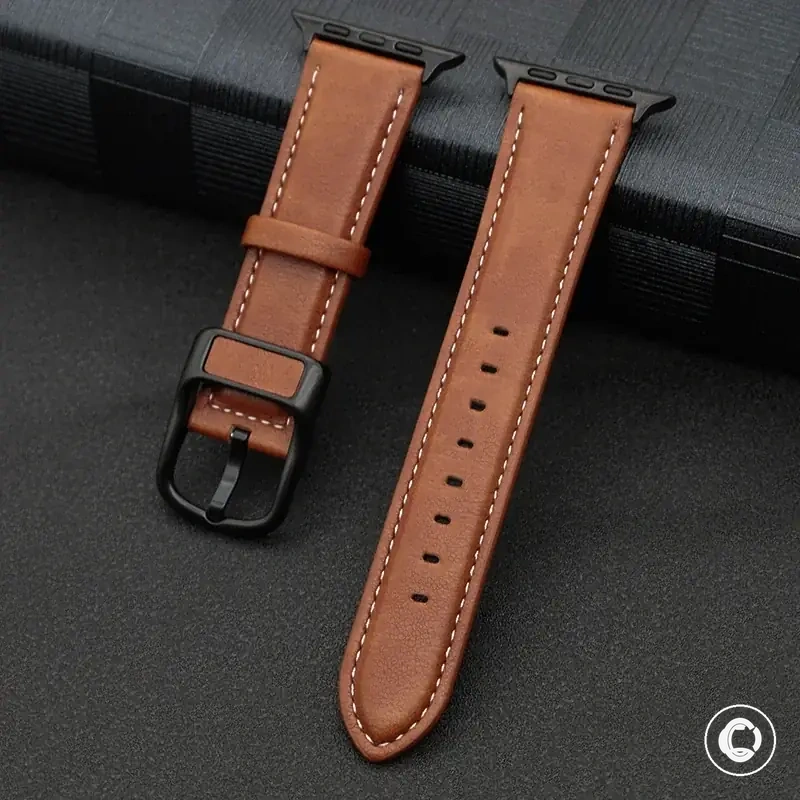
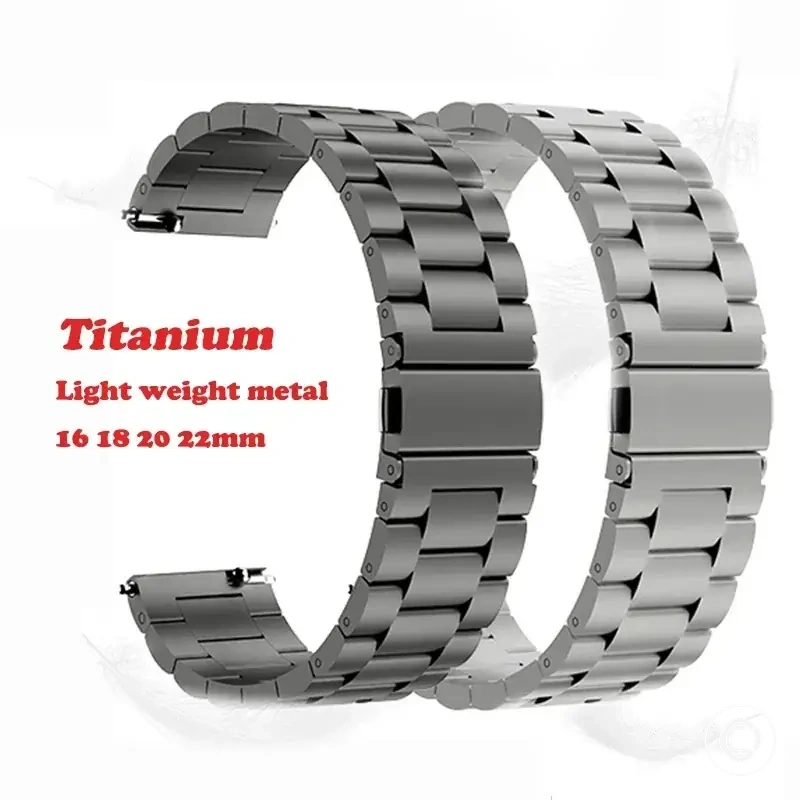
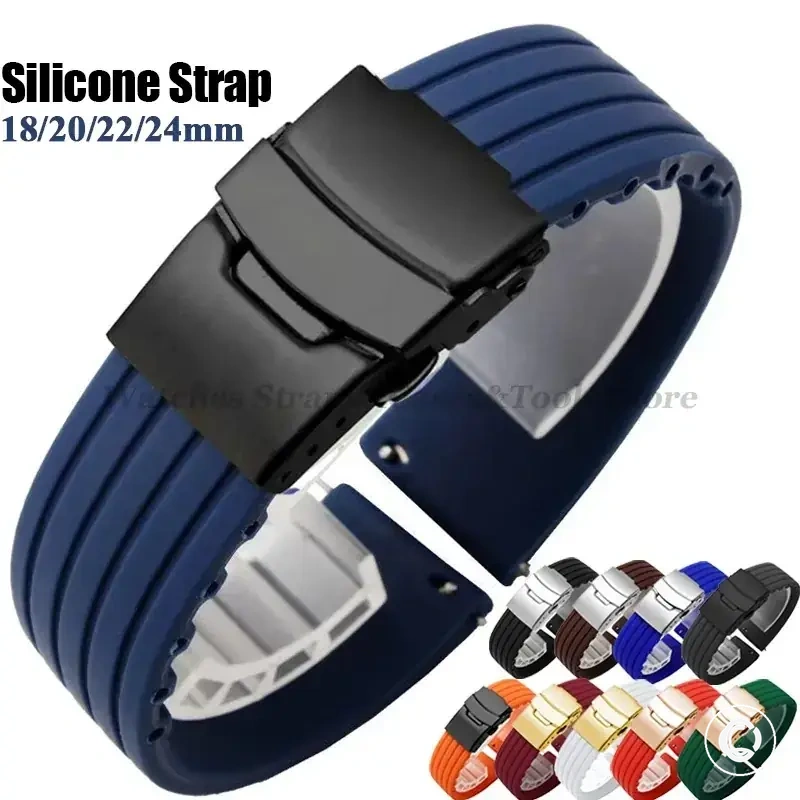
This chart shows the key durability indicators and value trade-offs to consider when evaluating a band before purchase.
Final Smartwatch Band Buying Checklist
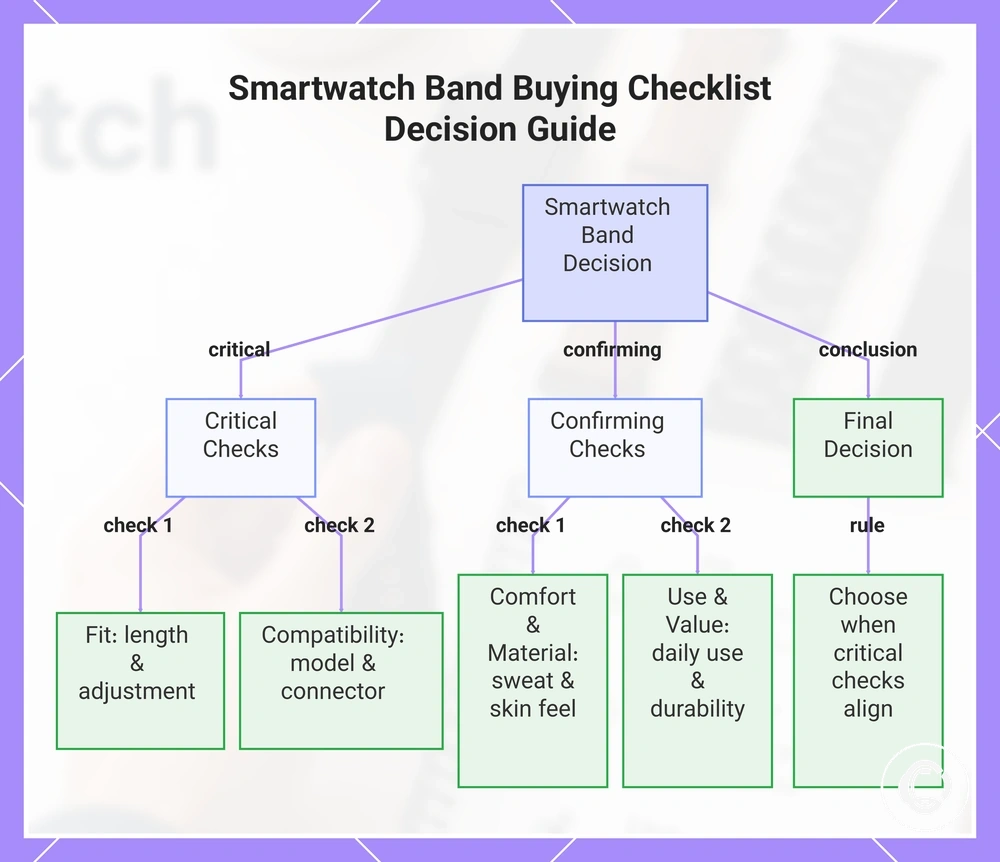
Use this buying checklist to pass, caution, or keep comparing before choosing a smartwatch band. Fit and compatibility are the critical checks. Comfort, material, use, and value help confirm whether the choice suits your wear context.
A pass means the band meets the required condition for that criterion. A caution means one factor may need closer review before selection. Keep comparing when a failed check could affect fit, compatibility, comfort, or long-term value.
Final Smartwatch Band Buying Checklist checks verify fit, compatibility, comfort, material, use, and value before the decision is made.
- Fit: Pass when the band length and adjustment range suit the wrist; use caution when the band feels too tight, too loose, or hard to adjust.
- Compatibility: Pass when the watch model, case size, and connector type align; keep comparing when the connector or adapter need is unclear.
- Comfort: Pass when weight, softness, breathability, edge finish, and clasp pressure feel suitable during wear; use caution when movement changes the feel.
- Material: Pass when the material matches sweat exposure, skin feel, care needs, and style fit; keep comparing when the material trade-off does not suit the use condition.
- Use: Pass when the feature set supports daily wear, exercise, work, travel, or style occasion needs; use caution when one band must cover very different wear situations.
- Value: Pass when durability signals, care burden, and replacement expectations match the intended wear pattern; keep comparing when poor construction may reduce long-term value.
- Final decision: Choose the band only when the critical checks align with the watch, wrist, and wear context; reconsider when any major check remains uncertain.
This chart shows the three key decision stages: critical checks, confirming checks, and the final rule for choosing a smartwatch band.
Fit, Compatibility, Comfort, Material, and Use Pass Checks
Each critical criterion should pass or be revisited before comparing specific smartwatch band options.
If a critical check fails, caution can override an otherwise attractive band. Keep comparing when fit, compatibility, comfort, material behavior, use fit, or value remains uncertain.
Fit, Compatibility, Comfort, Material, and Use Pass Checks verify the main selection criteria before option comparison.
- Compatibility: Pass when the watch model, case size, connector, and adapter need are clear; revisit when any watch-side match is uncertain.
- Fit: Pass when wrist adjustment, band length, and tightness range feel workable; revisit when the band sits too loose, too tight, or unstable.
- Comfort: Pass when weight, pressure, breathability, and edge feel suit the wearer context; revisit when movement or long wear changes comfort.
- Material behavior: Pass when sweat handling, skin feel, care needs, and style fit match the use condition; revisit when the trade-off feels unsuitable.
- Use fit: Pass when the band supports the main daily wear, exercise, work, travel, or style use case; revisit when one use condition conflicts with another.
- Value: Pass when durability signals and care burden match the expected wear pattern; keep comparing when weak construction may reduce long-term value.
When Another Band Is a Better Match
Another band may be a better match when a mismatch signal affects fit, comfort, fastening, value, or the intended use case. A technically compatible band can still be weaker for the way it will be worn. Reconsider the choice before comparing style or product options.
If the current band shows a mismatch during selection, revisit the relevant criterion before treating it as suitable. Another band may be better for a different use case even when the current band connects to the watch. When the signal is unclear, compare another band rather than forcing the current choice.
When Another Band Is a Better Match checks flag mismatch signals that may justify comparing another option.
- Incompatible connector: If the connector or adapter need is unclear, revisit compatibility and compare another band before assuming a fit.
- Poor adjustment range: If the band sits too loose, too tight, or between usable settings, limited wrist adjustment may make another band a safer option.
- Discomfort: If pressure, edge feel, or weight becomes noticeable during wear, revisit comfort before keeping the current band.
- Sweat problem: If sweat exposure creates moisture buildup or poor skin feel, material behavior may not suit the use case and another band may be a better match.
- Weak fastening: If movement exposes weak fastening or an unstable closure, revisit secure fit and compare a fastening style that better suits the activity.
- Poor value: If durability signals, care burden, or replacement risk feel weak for the intended wear pattern, keep comparing before choosing the band.