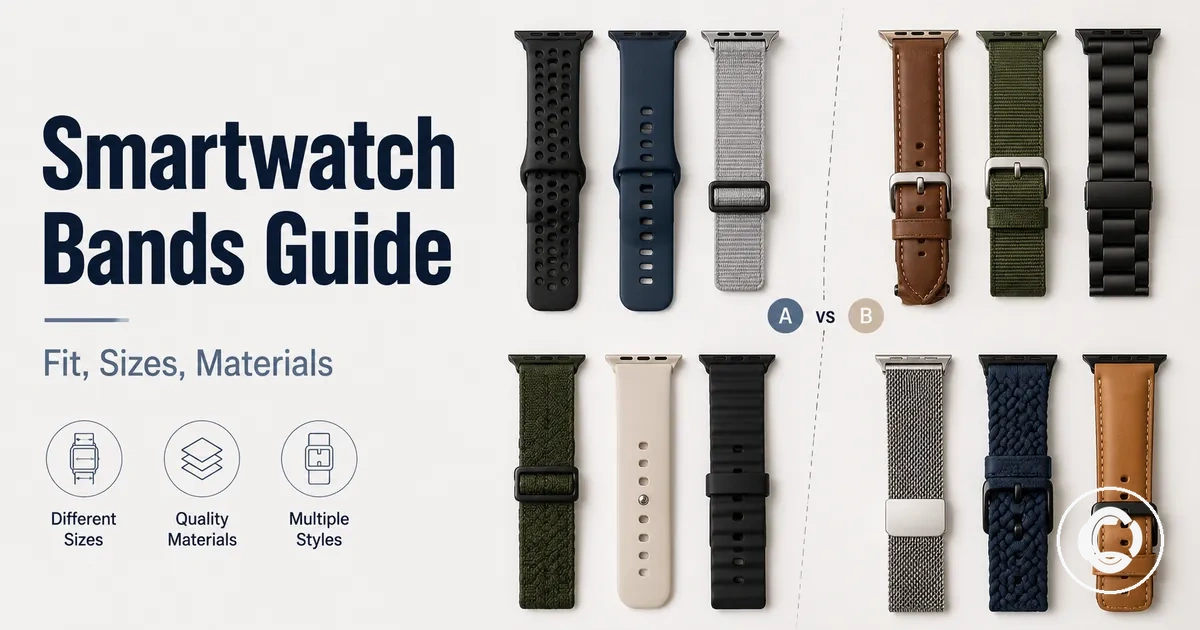
Smartwatch bands buying guide for fit, materials, and compatibility
Smartwatch bands are replacement straps that attach a watch case to the wrist and frame the buying decision around fit, compatibility, material, and use case. A suitable band depends on the watch model, connector type, band size, wrist fit, material feel, and intended use.
The right choice can vary by model, connector, band width, wrist size, material sensitivity, and daily conditions. A silicone, leather, metal, or nylon band may suit different comfort and care needs, but material preference alone does not prove compatibility. This guide treats smartwatch bands as a category-level decision subject, while product examples stay secondary to fit, connector, and use-case checks.
Smartwatch bands are separate from smartwatch devices, fitness bands, sensors, and medical features. Start by understanding what the band is, how it connects to the watch, and which conditions can affect a later price-check or external partner decision.
What smartwatch bands are and when replacement straps matter
Smartwatch bands are wearable strap components that attach a smartwatch case to the wrist. A band can be a replacement strap, a fitted strap, or part of an attachment system with lugs, pins, or an adapter. Its basic role is to hold the watch case against the wrist while supporting fit and comfort.
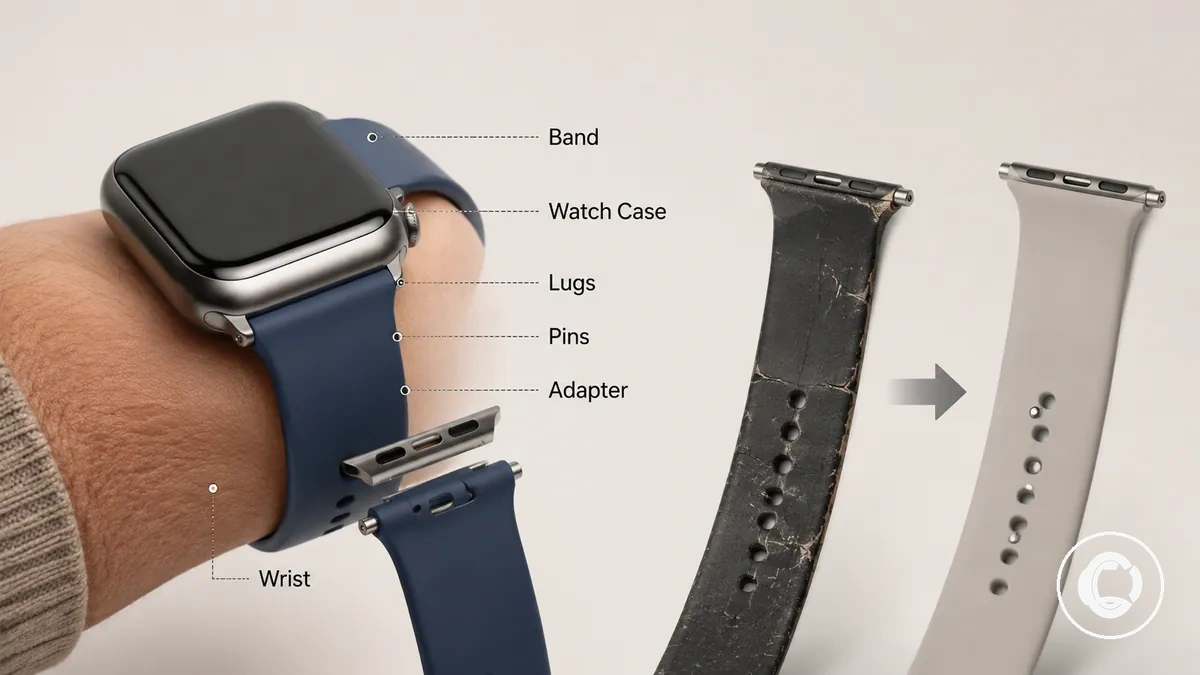
Replacement straps matter when the existing band shows wear, feels uncomfortable, no longer suits the use conditions, or creates a poor fit. A new strap may improve the wearing experience when the watch model, attachment method, and wrist fit are checked first. Replacement need should stay conditional because a worn band does not automatically mean any replacement band will fit or feel better.
Similar terms can describe different parts of the same attachment system, so the boundary matters before sizing or compatibility checks.
- Band: the wearable strap section that sits between the watch case and wrist.
- Strap: a controlled synonym for the band, often used when discussing replacement straps.
- Watch case: the smartwatch body that the band attaches to.
- Lugs and pins: attachment parts that may hold the band in place, depending on the watch design.
- Adapter: a connector part that may be needed when the band and watch case use different attachment shapes.
Smartwatch bands are not the watch case, device screen, or sensor system. A band can be a replacement part without automatically being compatible with a specific watch. The next checks should separate band size from connector compatibility before comparing materials or styles.
Smartwatch band sizes, wrist fit, and adjustment range
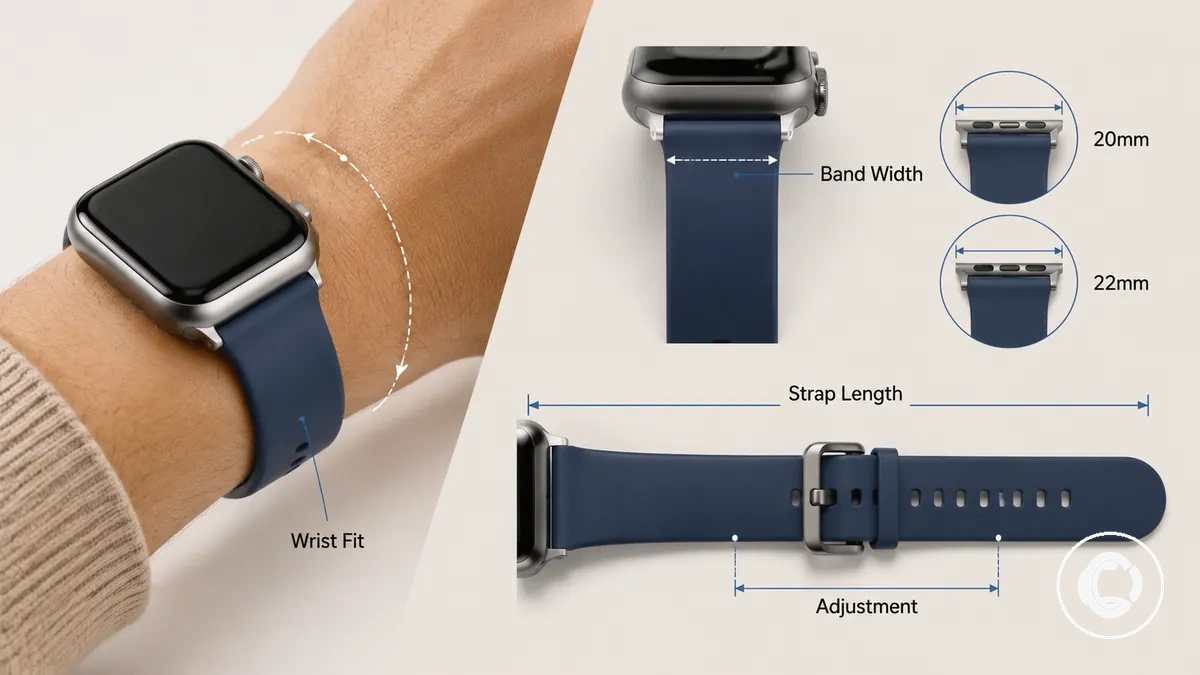
Smartwatch band size depends on both the watch-end width and the wrist-end fit. A suitable size combines band width, strap length, wrist circumference, and adjustment range rather than relying on a single measurement. The right choice is usually a conditional match between the watch and the wearer.
Smartwatch band sizes, wrist fit, and adjustment range involve separate measurements that affect different parts of the fit. Band width and lug width relate to the attachment side of the watch, while strap length and wrist measurements relate to wearability. The table below separates attachment sizing from wrist comfort and highlights the buying risk of overlooking either side.
| Measurement area | What to check | Why it matters | Risk if ignored |
|---|---|---|---|
| Watch-end width | Band width or lug width | Helps determine attachment compatibility | Band may not attach correctly |
| Strap length | Overall band length | Influences wrist fit | Band may feel too short or too long |
| Wrist circumference | Wearer wrist measurement | Supports comfort and adjustment planning | Reduced comfort or insecure wear |
| Adjustment holes or clasp range | Hole spacing or clasp adjustment | Allows fit refinement | Excess looseness or pressure points |
| Labelled sizes | 20mm or 22mm markings | Usually indicate attachment width | Confusing width labels with overall fit |
Wrist circumference and adjustment range influence how a band feels during daily wear. Hole spacing, clasp adjustment, and band length can affect how easily a secure fit is achieved. When adjustment options are limited, comfort and security may vary even if the attachment width is correct.
Labels such as 20mm and 22mm usually refer to the width of the attachment point rather than the full wearable size of the band. A 20mm or 22mm label can be a useful buying check, but compatibility and wrist fit may still depend on the watch model, connector system, strap length, and adjustment range. Relying on the label alone can increase buying risk.
Size decisions work best when watch-end measurements and wrist-end fit are evaluated together. For a more detailed measuring process, see the smartwatch band size guide.
Band width, lug measurement, and common strap sizes
Labelled strap size usually refers to the width at the watch attachment point. A 22mm label, for example, commonly describes the band width or connector opening measurement rather than overall wearable fit. The correct size still depends on the lug measurement at the attachment point.
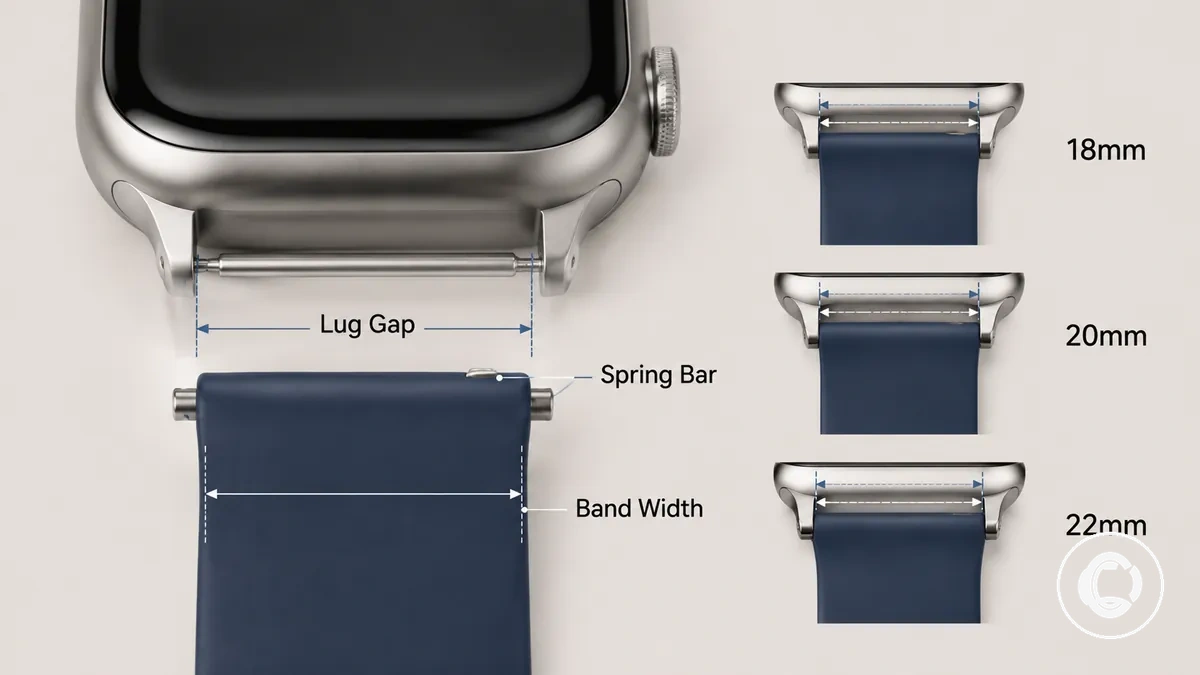
Band width, lug measurement, and common strap sizes help organize label meaning and attachment conditions.
- 18mm: a common labelled strap size based on attachment width.
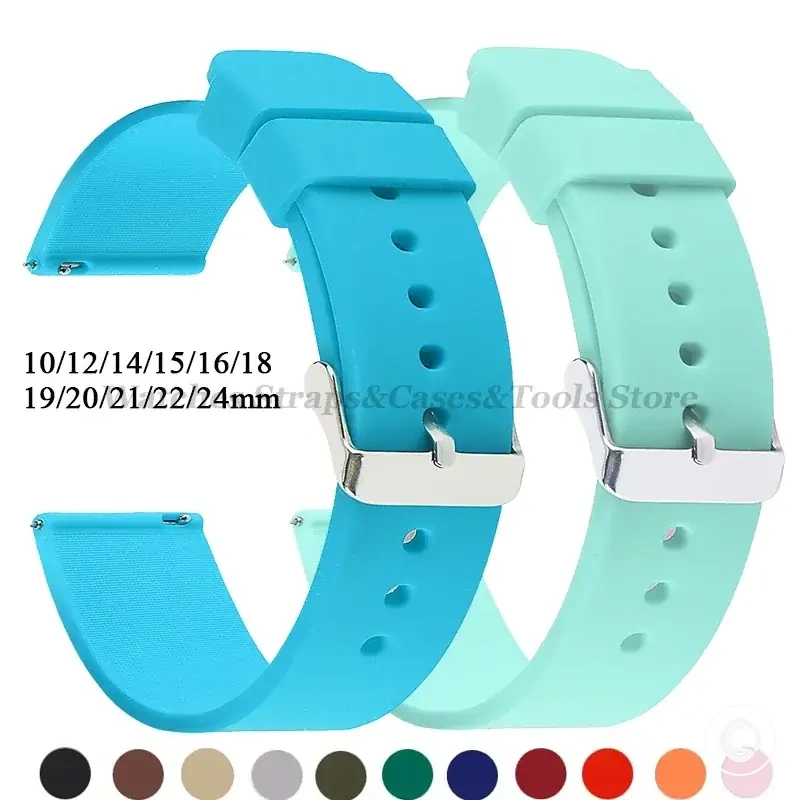
- 20mm: a common width label often used for lug width, strap width, or connector opening matching.
- 22mm: a common label that usually refers to the band end, lug width, or connector opening measurement.
- Spring bar width: the attachment hardware should align with the lug opening and band width.
Adapters, proprietary connectors, and case-specific attachment designs can change the result even when the labelled strap size appears correct. A standard spring bar width may not be sufficient when a watch uses a different connector system. Treat width labels as an attachment condition rather than proof of compatibility.
Wrist size, strap length, and secure everyday fit
Wrist circumference and strap length affect both secure fit and comfort during daily wear. A band that matches the attachment size may still feel too loose or too tight if the adjustment range does not suit the wrist size. Everyday fit depends on the relationship between wrist circumference, strap length, and wearing conditions.
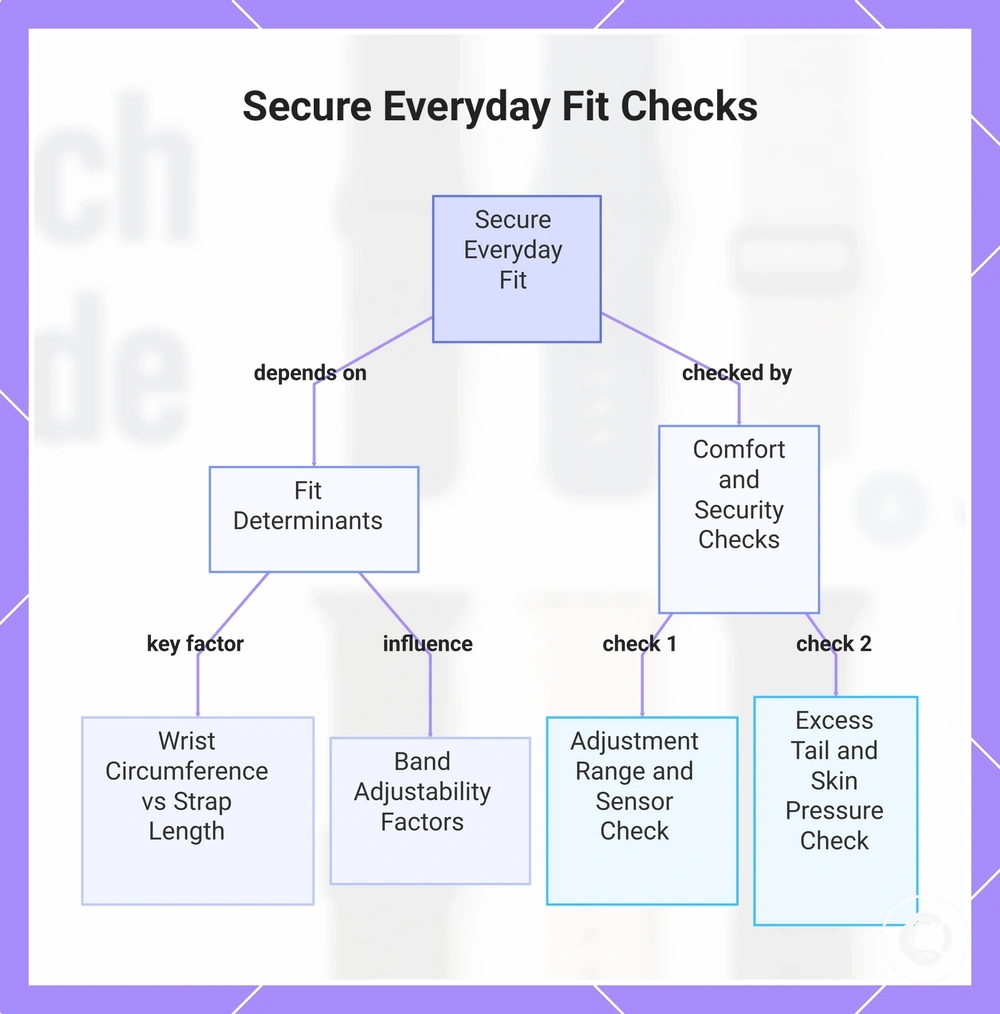
Hole spacing, clasp position, stretch, and excess tail can change how a band feels throughout the day. Smaller wrists may leave more excess tail, while larger wrists may require more available band length and adjustment range. Wrist size, strap length, and secure everyday fit can be checked through the following comfort and security conditions:
- Check whether the adjustment range allows a secure fit without excessive tightness or looseness.
- Confirm that hole spacing or clasp position provides enough strap adjustment for the intended wearing condition.
- Verify that sensor contact remains reasonably consistent during normal movement when the watch uses wrist-based sensors.
- Look for excess tail that may catch on clothing or become distracting during active use.
- Pay attention to skin pressure that may increase when the band feels overly tight for the wrist size, band material, or wearing duration.
These checks help differentiate attachment size from everyday wrist fit. For more context on wearer-focused comfort considerations, see comfortable smartwatch bands.
This chart shows the main factors that determine secure everyday wrist fit and the key checks to evaluate comfort and security.
Smartwatch band compatibility by watch model and connector system
Compatibility depends on the watch model, connector system, band width, and any adapter requirements. Smartwatch bands are not universally compatible, and not all watch bands fit all watches. A compatible band requires attachment conditions that support a fit, non-fit, or conditional fit outcome.
The watch model and case size help qualify whether a band is designed for a specific attachment layout. Even when two watches appear similar, differences in case size or lug width may affect compatibility. After confirming the watch model and attachment dimensions, connector checks become the next verification step.
Connector system details such as quick-release pins, a proprietary connector, or an adapter requirement can change the result. If the connector system differs, the band may need an adapter or may not attach correctly. Universal band claims should be verified against the actual attachment design rather than assumed.
Smartwatch band compatibility by watch model and connector system can be verified through a few practical checks. These checks focus on mechanical attachment compatibility rather than wrist comfort.
- Confirm the watch model before comparing replacement bands.
- Check whether the case size and lug width align with the intended band.
- Verify the connector system, including quick-release pins or other attachment hardware.
- Determine whether a proprietary connector requires an adapter.
- Review any universal band claim carefully and verify attachment details before reducing mismatch or return-risk concerns.
These checks help reduce compatibility uncertainty and separate watch fit from everyday wearing comfort. For a deeper look at verification criteria and conditional-fit situations, see smartwatch band compatibility.
This chart outlines the key verification steps to determine if a smartwatch band fits a specific watch model, focusing on mechanical attachment compatibility.
Universal bands, quick release pins, and brand-specific fittings
Universal bands, quick release pins, and brand-specific fittings differ by connector behavior rather than strap width alone. Universal bands usually still require verification of strap width and connector behavior before a conditional fit can be assumed. Compatibility depends on how the connector shape aligns with the watch attachment design.
Spring bars and quick-release tabs often use similar attachment principles, while proprietary slots and branded fittings may require a different connector fit or an adapter. An adapter can help in certain situations, but its usefulness may depend on connector shape, case end design, and seating requirements. A watch may require a specific connector shape even when the strap width appears correct, so the comparison below separates these connector conditions.
| Connector condition | What it means | What to verify |
|---|---|---|
| Standard spring bars | Uses spring bars within a standard connector opening | Strap width and connector opening alignment |
| Quick-release pins | Uses spring bars with integrated quick-release tabs | Connector fit and attachment design compatibility |
| Proprietary fittings | Uses proprietary slots or branded fittings | Required connector shape and attachment method |
| Adapter-based bands | Uses an adapter between the band and watch attachment | Adapter shape, seating fit, and connector requirements |
Main smartwatch band materials and their practical trade-offs
Material choice changes comfort, care, durability, and style in different ways. No single smartwatch band material suits every wearer because water exposure, cleaning preferences, skin feel, and daily use conditions can vary. The most suitable option usually depends on balancing practical material trade-offs rather than prioritizing one attribute alone.
Main smartwatch band materials and their practical trade-offs influence everyday wear, maintenance, and appearance. The table below compares comfort tendency, care need, use-case fit, and trade-offs across common material types.
| Material | Comfort tendency | Care need | Better fit when | Trade-off |
|---|---|---|---|---|
| Silicone | Flexible with a soft skin feel | Usually easy to clean | Frequent workouts or sweat exposure | Breathability may vary by design |
| Leather | Comfortable feel for many wearers | Often benefits from additional care | Office wear or style-focused use | Water exposure may require caution |
| Metal | Structured feel with durability emphasis | Periodic cleaning may be needed | Dress-oriented or long-term wear | Weight may feel different from softer materials |
| Mesh | Often lighter and more breathable than solid links | Regular cleaning may help maintain appearance | Daily wear with airflow preference | Fit feel can vary by clasp design |
| Nylon | Often breathable and lightweight | May need cleaning after heavy use | Long daily wear or casual use | Drying time can vary after moisture exposure |
| Fabric | Soft feel and flexible wear | Cleaning needs depend on construction | Comfort-focused daily use | Durability may vary by weave and finish |
| Rubber | Flexible with grip-oriented characteristics | Usually straightforward to clean | Wet use or active conditions | Skin feel may vary by material formulation |
Silicone, leather, metal, mesh, nylon, fabric, and rubber compare differently across comfort, durability, sweat resistance, breathability, cleaning, and style. Silicone is commonly associated with sweat resistance and easier cleaning, while leather is often selected for appearance and may require more care around water exposure. Metal and mesh can emphasize durability, whereas nylon, fabric, and rubber may appeal to wearers prioritizing breathability, flexibility, or comfort under specific use conditions.
Sensitive skin, workouts, water exposure, and long wear can all influence material choice. For example, smartwatch bands for workouts are often evaluated through sweat resistance, grip, cleaning effort, and comfort during movement. Skin feel can vary by finish, coating, cleaning routine, and individual sensitivity, so material suitability remains conditional.
Material trade-offs become clearer when comfort, durability, care need, breathability, and style are considered together. For a deeper comparison of material-specific characteristics and trade-offs, see smartwatch band materials.
Smartwatch strap types, fastening styles, and category-level differences
Strap types combine construction, fastening styles, and wearing behavior into a category-level choice. Different strap types can affect fit, security, adjustability, and appearance in different ways. The most suitable option usually depends on how construction and fastening characteristics interact with the intended wearing experience.
Sport straps, leather straps, metal bracelets, mesh loops, nylon bands, and elastic bands represent distinct construction approaches. Sport straps are often associated with secure fit during workouts, while leather straps are commonly connected to style-oriented or office wear situations. Metal bracelets, mesh loops, nylon bands, and elastic bands differ in weight, flexibility, adjustability, and wearing feel, so construction type can influence use-case suitability.
Buckle closures, magnetic closures, clasp systems, and loop designs create different fastening behaviors. A buckle typically uses fixed adjustment points, while a magnetic closure may allow quicker adjustment changes and a clasp may emphasize structured fastening. These fastening styles help explain why similar strap types can produce different security and adjustability outcomes, as shown below.
| Strap or fastening type | Main attribute | Practical effect | Watch-out |
|---|---|---|---|
| Sport strap | Secure-fit focused construction | Often supports active movement | Comfort may vary by fit and material |
| Leather strap | Style-oriented appearance | Often suits office or formal settings | Care needs may increase with water exposure |
| Metal bracelet | Structured construction | Can emphasize durability and appearance | Weight may feel different from softer designs |
| Mesh loop | Flexible metal construction | Often allows fine adjustment | Closure performance depends on design |
| Nylon band | Lightweight construction | Often supports breathable wear | Wear characteristics vary by weave |
| Elastic band | Stretch-based fit | Can simplify on-and-off use | Fit may change with extended use |
| Buckle | Hole-based adjustment | Provides fixed adjustment points | Adjustment range depends on spacing |
| Magnetic closure | Continuous adjustment style | Can allow quick fit changes | Holding strength varies by design |
| Clasp | Mechanical locking system | Often supports structured fastening | Operation varies by clasp type |
These category-level distinctions separate construction type from fastening style without creating a complete taxonomy of designs. For a deeper breakdown of categories and subtype differences, see smartwatch band types.
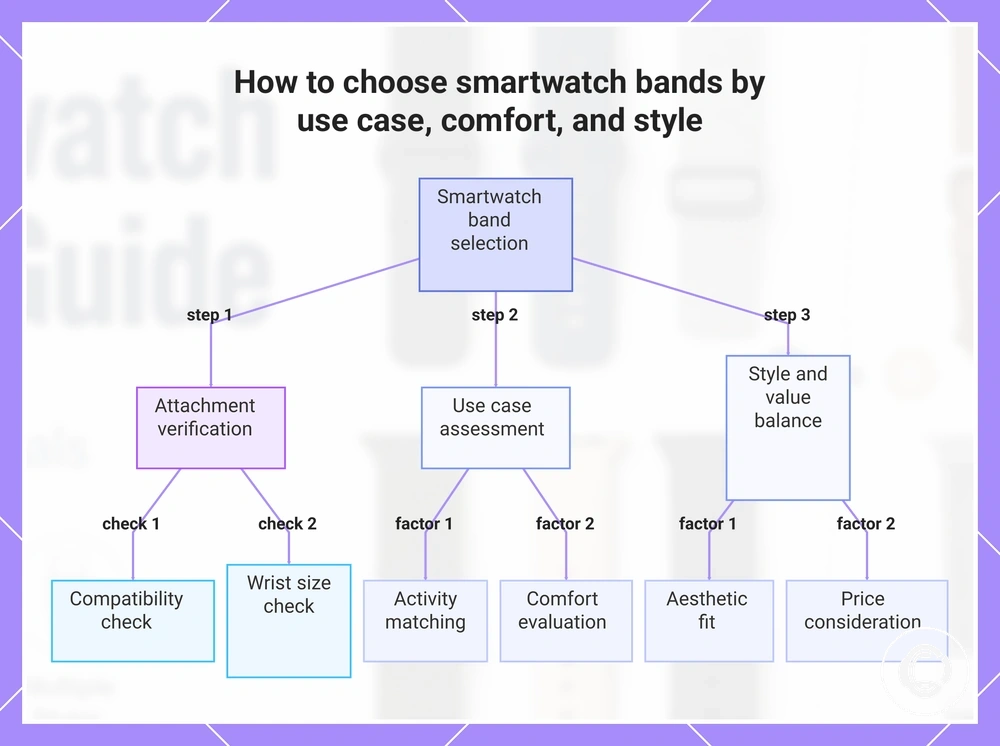
How to choose smartwatch bands by use case, comfort, and style
Choosing a smartwatch band depends on matching compatibility, wrist fit, material comfort, activity level, and style to the intended use case. A suitable band should satisfy attachment conditions first and then support the preferred wearing experience. The right band choice often depends on how these criteria align with daily use and personal comfort tolerance.
Watch model, connector type, and size are non-negotiable verification checks before comparing preferences. A band that does not meet attachment requirements may not be suitable regardless of material or appearance. Verification should come before evaluating comfort, style, or value-related preferences.
Different use cases can shift the importance of specific criteria. Daily wear may prioritize comfort and adjustment, workouts may place more emphasis on secure fit and breathability, while office use may increase the importance of style. Sensitive skin, wet conditions, and activity level can also influence material comfort and wearing preferences, which is why how to choose smartwatch bands starts with matching criteria to the intended use case.
How to choose smartwatch bands by use case, comfort, and style becomes easier when decision signals are reviewed together.
- Compatibility: Confirm the watch model, connector system, and attachment requirements.
- Size: Check that wrist fit and adjustment range suit the intended wearer.
- Material: Consider material comfort, breathability, and expected exposure to sweat or wet conditions.
- Activity: Match the band to daily wear, workouts, office use, or other regular activities.
- Comfort: Evaluate secure fit, skin feel, and long-wear suitability based on personal preferences.
- Style and value: Balance appearance, expected use, and price-check considerations before reviewing examples.
These decision signals help narrow suitable options without relying on broad rankings or universal recommendations. Selection works best when compatibility, fit, comfort, activity requirements, and style preferences are evaluated together before comparing individual examples.
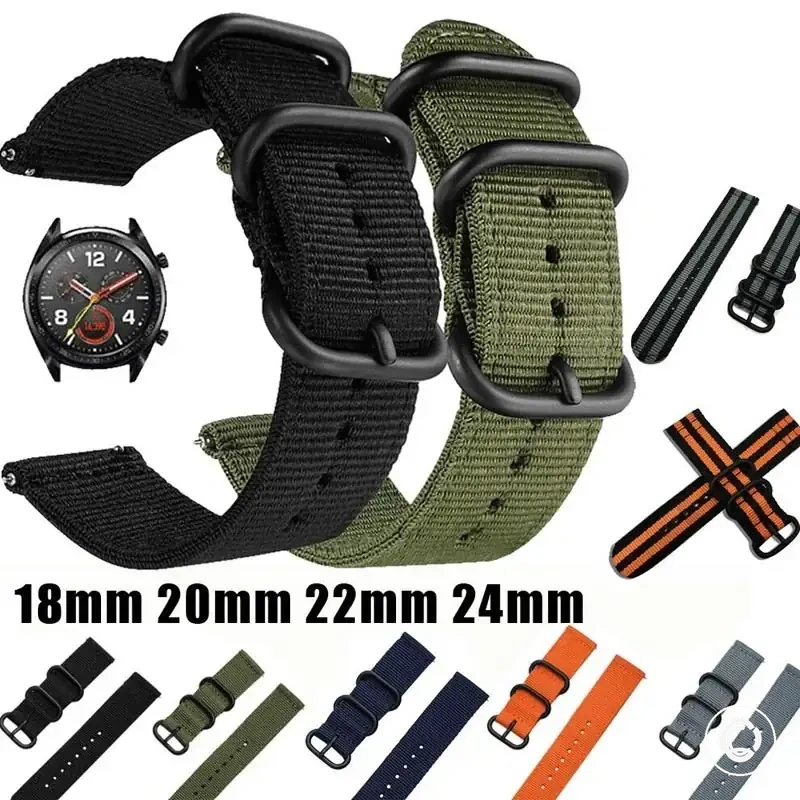
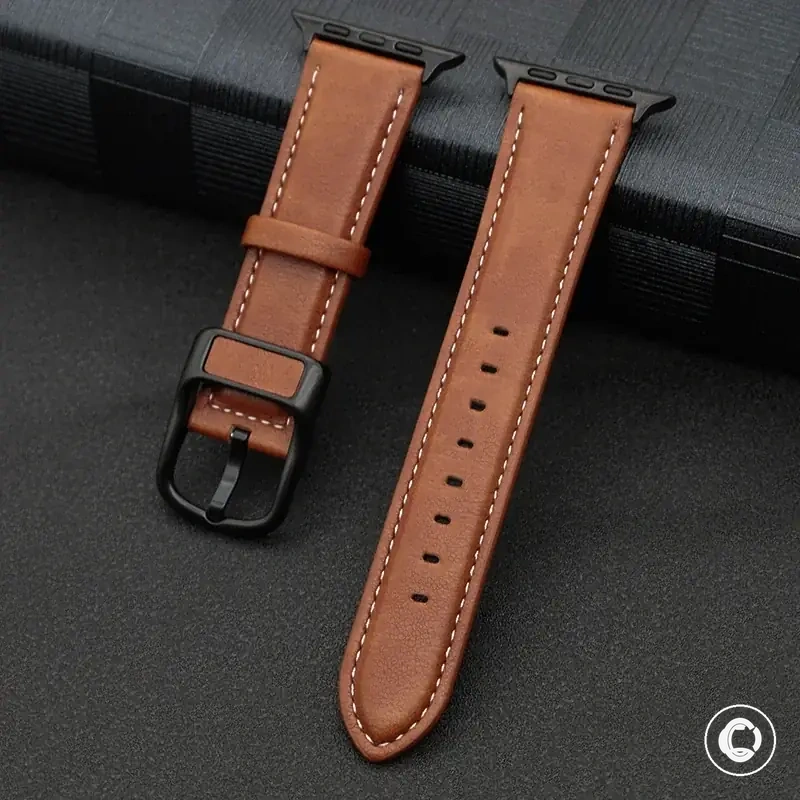
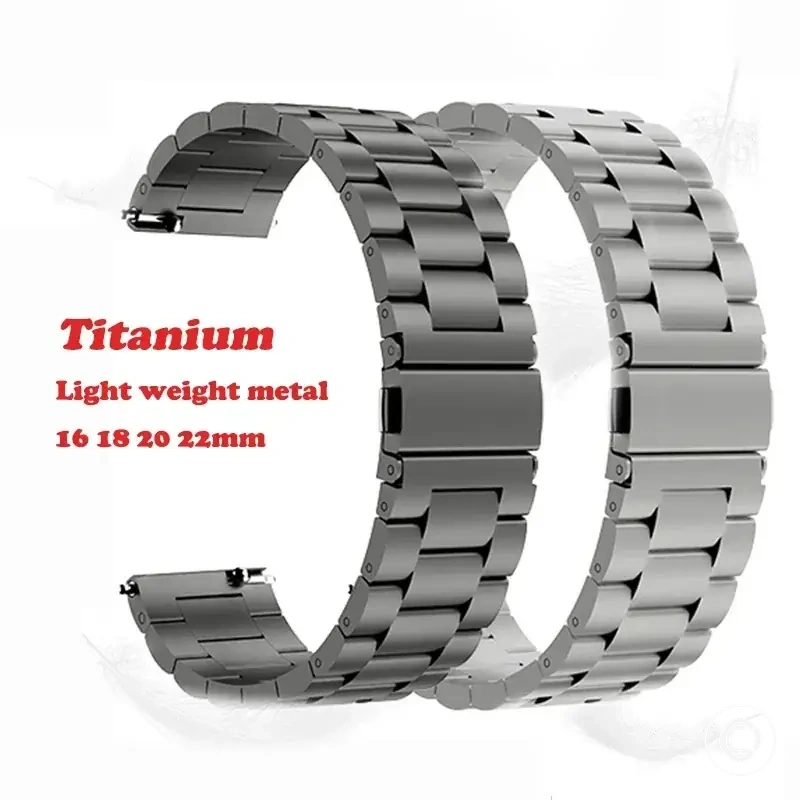
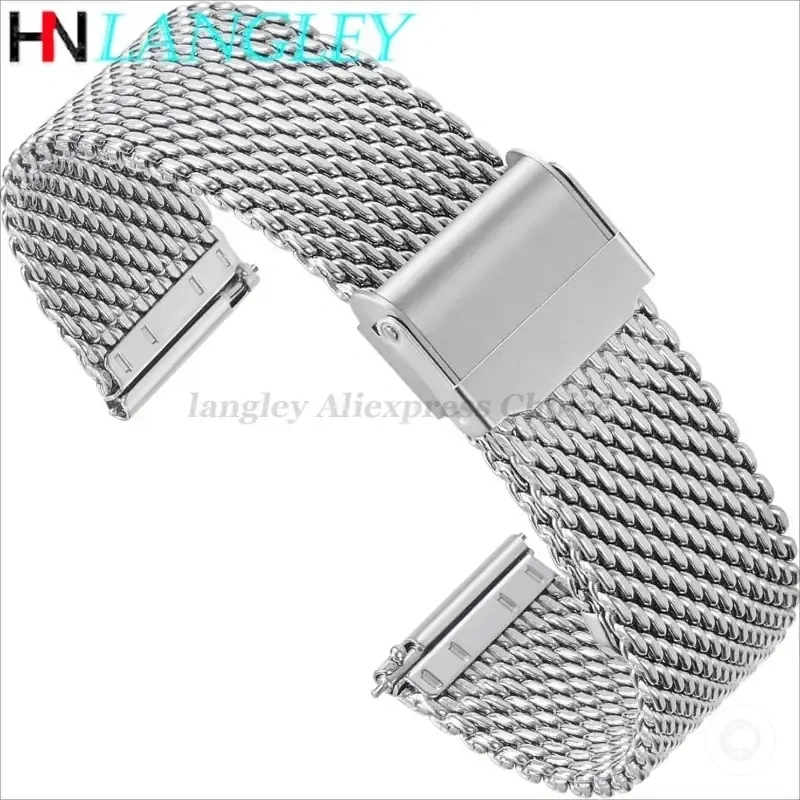
The products below are useful examples for comparing available options. Before buying, check that the compatibility criteria, key features, and product details match your needs.
This chart shows the step-by-step process for selecting a smartwatch band, starting with attachment verification, then evaluating use case and comfort, and finally balancing style and value.
Price, durability, and value signals before buying
Value depends on usable durability, comfort, connector reliability, and material quality rather than price alone. A lower price does not automatically indicate better value, and a higher price does not automatically indicate longer service life. Buying value is usually determined by how well a band's features align with expected use conditions and replacement frequency.
Material quality, clasp strength, connector reliability, and finish quality are practical value signals to evaluate before comparing examples. Stretch retention, sweat resistance, leather quality, and metal coating can vary by construction, care habits, and frequency of use. These factors may influence long-term wear characteristics, maintenance effort, and how often replacement becomes necessary.
Price-check behavior works best when it focuses on quality signals rather than the lowest price alone. Comparing materials, connector design, finish quality, warranty context, and expected use conditions can provide stronger decision support than comparing price in isolation. Product examples can be reviewed through external partners after the value criteria have been evaluated.
Price, durability, and value signals before buying become clearer when the following conditions are reviewed together.
- Connector quality: Check connector reliability and attachment security before focusing on appearance.
- Material finish: Evaluate material quality, leather quality, or metal coating based on expected wear conditions.
- Comfort retention: Consider whether comfort may remain suitable over regular daily wear.
- Sweat or water exposure: Match sweat resistance and use conditions to the intended activity level.
- Care burden: Compare cleaning and maintenance expectations across material types.
- Replacement frequency: Consider how wear patterns and use intensity may affect replacement needs over time.
These value signals help qualify whether an affordable or premium option is more appropriate for a specific use case. Affordable bands may suit lighter use or shorter replacement cycles, while premium bands may emphasize finish quality, material quality, or comfort characteristics that matter under more demanding conditions. The stronger value outcome depends on expected use, care habits, durability expectations, and price-check priorities rather than price range alone.
The products below are useful examples for comparing available options. Before buying, check that the compatibility criteria, key features, and product details match your needs.
This chart shows the main value signals to evaluate before buying a watch band, covering quality checks, use conditions, and the resulting choice between affordable and premium options.
Replacement, care, and fit checks after buying
After buying a replacement band, check secure attachment, comfort, and material condition before treating the band as suitable for regular use. Simple fit checks can confirm whether attachment seating, clasp closure, and wrist feel are acceptable for everyday wear. The band should pass basic verification before longer wear or heavier activity.
Attachment seating should feel stable at the watch case, and strap movement should not suggest looseness at the connector. Clasp closure should hold under normal movement, while excess strap length should sit in a way that does not catch or distract. If the band shifts, opens, or sits unevenly, the fit may need rechecking before regular use.
Skin pressure, sweat buildup, cleaning suitability, and early wear signs should be reviewed after short wear periods. Material condition can vary by band material, sweat exposure, cleaning method, and wearer sensitivity. Replacement, care, and fit checks after buying help protect comfort, attachment security, and material condition through the following checks.
- Attachment: Confirm that attachment seating is stable at the watch case.
- Clasp: Check that clasp closure holds during normal wrist movement.
- Movement: Look for strap movement that may signal looseness or poor seating.
- Comfort pressure: Notice skin pressure without treating it as a medical diagnosis.
- Excess strap: Check whether excess strap length catches, rubs, or distracts during use.
- Care suitability: Match cleaning suitability to the band material and visible sweat buildup.
- Early wear: Watch for early wear signs such as stretching, surface change, or closure weakness.
For deeper maintenance guidance after care-related checks, see cleaning smartwatch bands. Persistent irritation, odor, loose fit, visible damage, or repeated closure problems may require separate support context beyond these simple post-buying checks.
This chart shows the key post-buy checks for a replacement watch band, covering attachment security, comfort, and material condition, including a warning about persistent issues.