
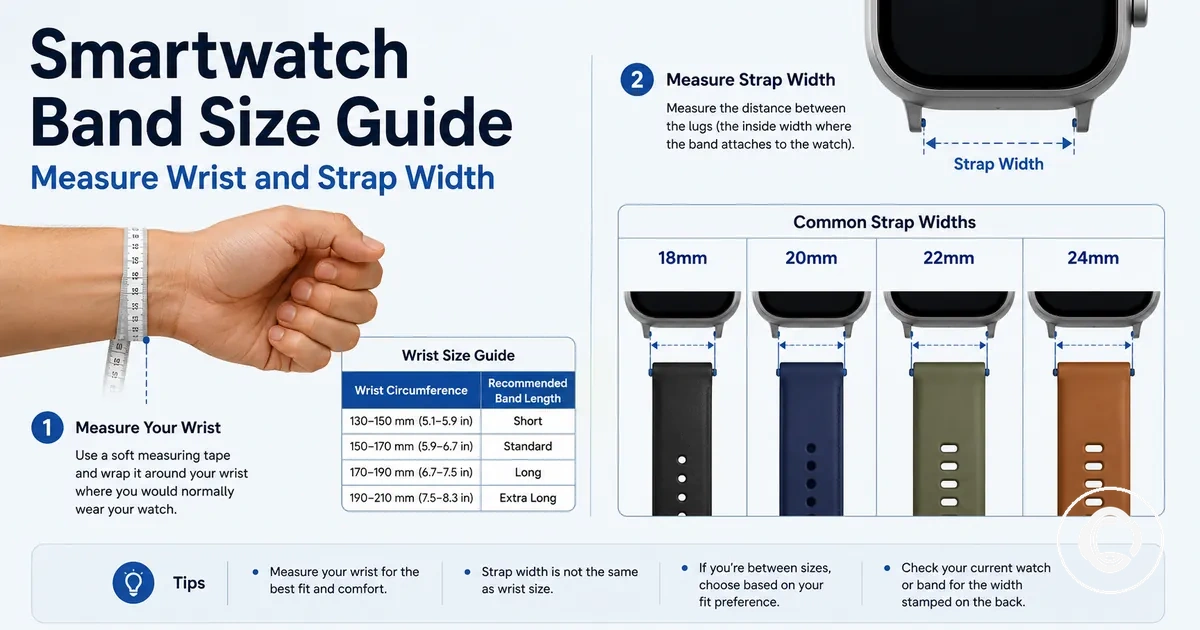
Smartwatch Band Size Guide
The right smartwatch band size depends on measured band width and wrist circumference. Band width controls the watch-side fit, while wrist circumference helps narrow the usable strap length. These are the two main sizing inputs: band width and wrist circumference.
A smartwatch band size is usually described in millimetres for the watch-side width and by strap length or adjustment range for the wrist-side fit. Lug width is the space where the replacement band meets the watch case, and strap length affects how the band closes around the wrist. A size chart can help organize short strap and long strap decisions, but size and compatibility are related, not identical.
If the old watch strap is missing, worn, or unclear, start by measuring instead of shopping by guesswork. The connector, watch model, clasp design, and comfort tolerance may still need confirmation after the band size is known. Use this guide to measure the smartwatch band before comparing replacement options.
Smartwatch band measurements that control fit
Smartwatch band measurements are the size references that determine how a band connects to the watch and how it sits on the wrist. Each measurement describes a different part of fit rather than the same dimension from another angle. The measurements that control fit are band width, lug width, wrist circumference, and strap length.
The most important smartwatch band measurements depend on both the watch side and the wrist side. Within the broader category of smartwatch bands, watch band size is usually evaluated by matching width measurements to the watch and length measurements to the wrist. A correct size can support fit and help guide a replacement choice. In contrast, size alone does not automatically confirm compatibility.
If watch band size, wrist size, and compatibility details seem mixed together, separating the measurements first can make fit decisions clearer. Smartwatch band measurements that control fit are easier to understand when each measurement point is viewed separately. Understanding the measurement order helps create a clearer fit assessment before using any chart.
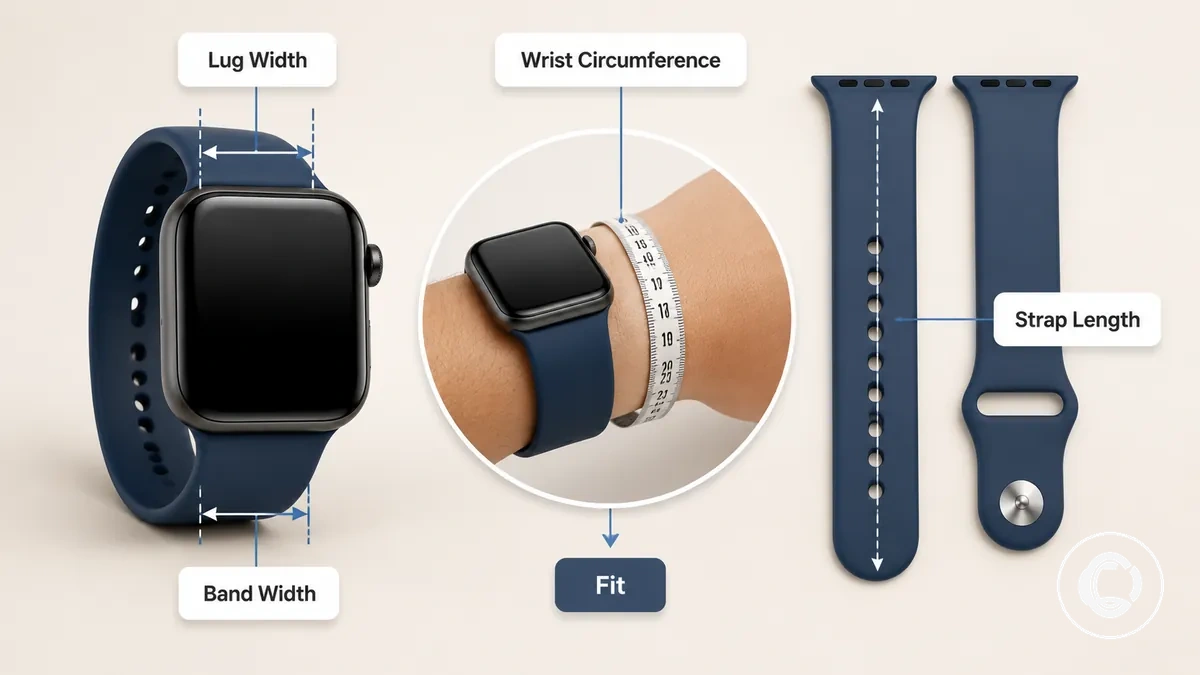
The diagram labels the measurement points that work together to influence fit, comfort, and replacement choice. Each measurement describes a different attribute of the smartwatch band.
- Band width: The width of the band where it attaches on the watch side, usually expressed in millimetres.
- Lug width: The distance between the watch lugs where the band connects on the watch side.
- Wrist circumference: The measurement around the wrist that helps determine the usable fit range.
- Strap length: The length of the band sections that affects adjustment range and comfort.
Strap width, lug width, wrist circumference, and strap length
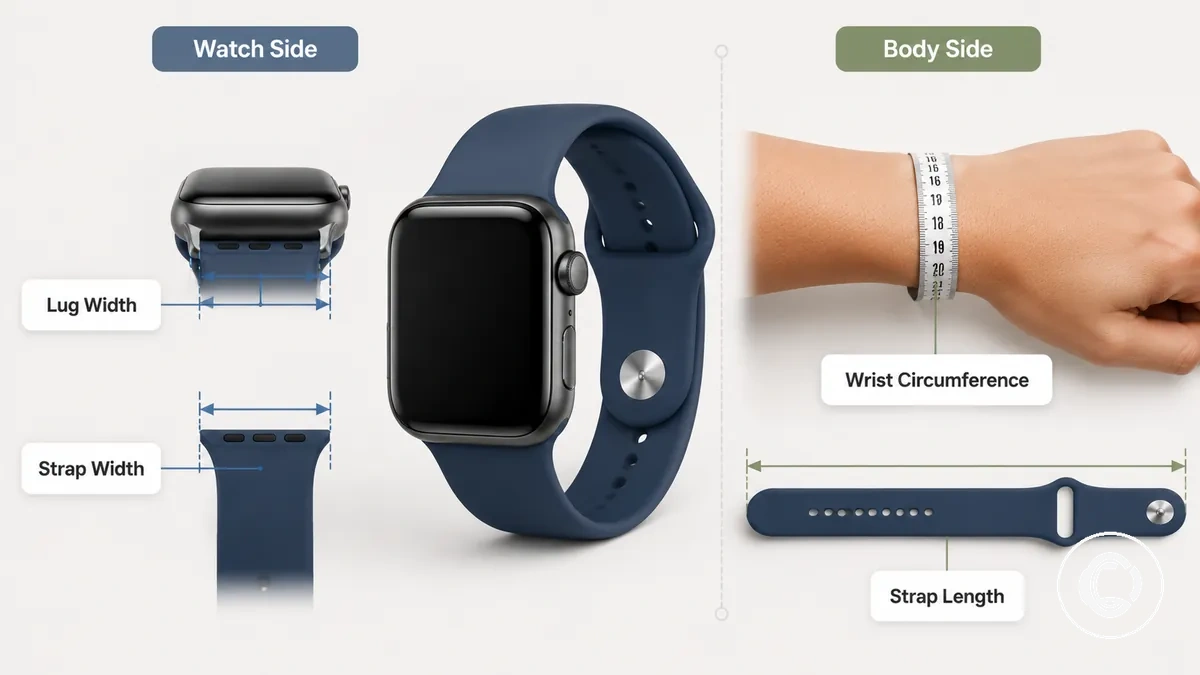
Strap width, lug width, wrist circumference, and strap length are sizing attributes that describe different parts of smartwatch band fit. Strap width and lug width are watch-side measurements, while wrist circumference and strap length relate to the body-side fit output. These attributes should be read together.
When a replacement choice depends on both watch dimensions and wrist size, separating the attributes can make the decision clearer. Strap width and lug width describe watch-side values, while wrist circumference and strap length relate to body-side fit output. A width value and a length value support different decisions, making width-versus-length an important distinction.
| Measurement | Where to check it | Typical value format | What it affects |
|---|---|---|---|
| Strap width | Watch-side band attachment area | Millimetres | Watch-side sizing decision |
| Lug width | Watch-side lug gap | Millimetres | Band connection sizing |
| Wrist circumference | Body-side wrist measurement | Wrist size value | Fit assessment |
| Strap length | Band total length | Length value | Body-side fit output |
Size labels that do not replace a compatibility check
A size label can help identify band width, but it does not confirm every compatibility condition. A stamped size, printed size, or marked width usually refers to a band width value and its measurement point rather than the entire fit outcome. A size label is only one signal.
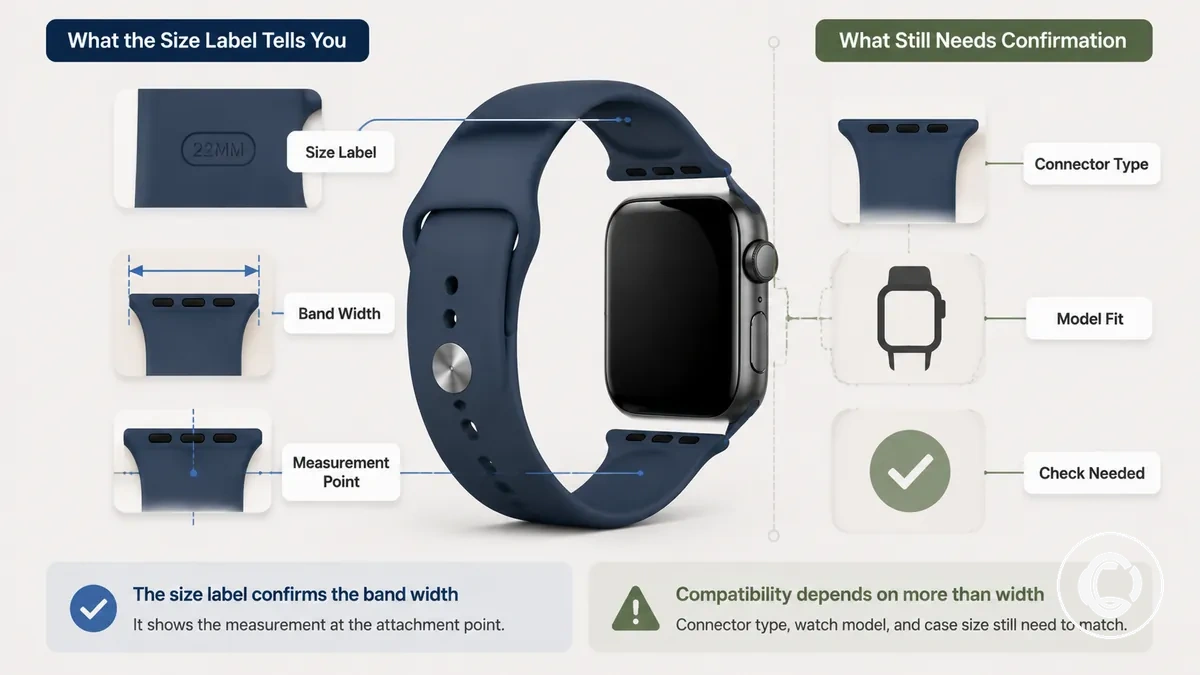
Size labels that do not replace a compatibility check become clearer when size information is separated from connection details. The image highlights what a size mark can identify and what still requires confirmation.
| Size label tells you | Size label does not confirm |
|---|---|
| Width value | Connector condition |
| Measurement point | Watch-model fit |
| Band width reference | Compatibility outcome |
| Stamped size in millimetres | Whether every fit condition is met |
A common assumption is that a matching width number automatically means a matching fit. In practice, connector type and watch-model fit may still need confirmation because a size label describes only part of the sizing decision. The risk comes from treating a width value as full proof of fit rather than checking the remaining conditions, which is the compatibility-check boundary addressed in smartwatch band compatibility.
Smartwatch band size chart
A smartwatch band size chart is a sizing reference for band width, wrist range, and strap length category decisions. Common band width values often include 18mm, 20mm, and 22mm, while short strap, regular strap, and long strap categories help describe adjustment range. The chart is a reference, not a guarantee.
A smartwatch band size chart helps organize width and length checks in one place. Band width relates to the watch-side sizing decision, while wrist range and strap length category help estimate the intended fit outcome. When an old band or watch case is available, verify chart values by measuring.
| Measurement need | What to check | Common value type | Why it matters |
|---|---|---|---|
| Width | Band width | 18mm, 20mm, 22mm | Helps identify the watch-side size reference |
| Wrist range | Wrist size range | Small, medium, or larger wrist range | Helps narrow the expected fit range |
| Strap length | Strap length category | Short strap, regular strap, long strap | Supports adjustment and wearing comfort |
| Verification method | Measure the available band or watch case | Measurement check | Helps verify chart values before selection |
Common 18mm, 20mm, and 22mm strap widths
Common strap widths are measurements taken across the band end or lug gap and are expressed in millimetres. The values 18mm, 20mm, and 22mm represent strap width sizes rather than watch size categories.
A common assumption is that close width values can be swapped without affecting fit. In practice, a strap that is too narrow may leave movement or a gap, while a strap that is too wide may create pressure against the connection area or may not fit the opening. For this reason, 20mm and 22mm should not be treated as interchangeable unless the watch system explicitly supports it.
| Width | Where it is measured | What to verify | Risk if wrong |
|---|---|---|---|
| 18mm | Across the band end or lug gap | Measure the connection width in millimetres | Too narrow may create movement or a gap |
| 20mm | Across the band end or lug gap | Confirm the measured strap width matches | Too narrow or too wide may affect fit |
| 22mm | Across the band end or lug gap | Check the available width before selection | Too wide may create pressure or non-fit risk |
Wrist size ranges for short, regular, and long straps
A wrist size range is a length-fit reference that connects wrist circumference to a strap category. Short strap, regular strap, and long strap labels describe band length options that may suit different wrist ranges, but usable length can vary with clasp design and adjustment holes. Wrist circumference helps guide the choice of strap category.
If a wrist circumference falls near the edge of a wrist size range, the remaining adjustment holes and usable length may become more important than the strap label alone. Because clasp design, adjustment holes, and band length differ between products, it is often useful to remeasure and choose conditionally when a wrist is near the edge of a range.
| Wrist range | Strap category | Check before choosing | Fit risk |
|---|---|---|---|
| Smaller wrist range | Short strap | Check remaining adjustment holes and tail length | Usable length may vary by clasp design |
| Mid-range wrist circumference | Regular strap | Verify adjustment range and band length | Fit outcome depends on usable length |
| Larger wrist range | Long strap | Confirm remaining range after fastening | Available adjustment may vary by clasp design |
How to measure smartwatch band width
To measure smartwatch band width, measure the distance across the lug gap or across the band end in millimetres. The measurement point is the space where the band connects to the watch or the width of the removed band end.
- Choose a ruler or caliper that displays millimetres, and place it against the lug gap or band end without tilting the tool.
- Measure straight across the lug gap if the band is removed, taking the reading from one inner edge to the opposite inner edge.
- Measure across the band end if the old band is available, and check that worn edges do not affect the reading.
- Read the width value in millimetres and record the result as the strap width measurement.
- Use the recorded value as the replacement-band width reference, matching the measured width rather than estimating by appearance.
If the measurement seems unclear, using a caliper instead of a ruler may provide a more precise reading. Recording the value in millimetres helps distinguish between common widths such as 18mm, 20mm, and 22mm because replacement-band width is measured in millimetres.
If the reading falls between common widths, measure again from the same lug gap or band end before making a decision. A borderline reading can result from a worn old band or an imprecise watch case measurement, so recheck the value before choosing a width.
This chart shows the measurement points, accurate technique, and how to apply the result for smartwatch band width measurement.
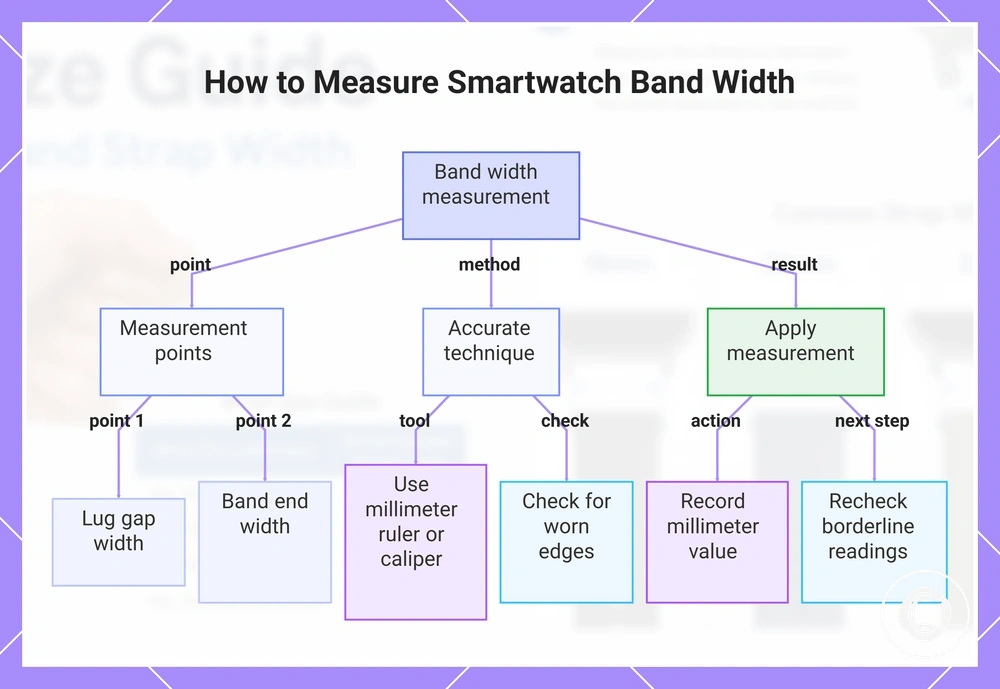
Measure the lug gap or band end in millimetres
Measure the lug gap or band end in millimetres by placing a ruler or caliper across the connection width and reading the distance at the exact measurement point. The correct measurement point is the space between the inside lugs or the width of the band end.
- Place a ruler or caliper across the inside lugs and keep the tool aligned with the lug gap.
- Read the distance between the inside lugs in millimetres and avoid measuring from the outer edges.
- Measure the band end with a caliper if the old strap is available, keeping the tool square to the strap end.
- Compare the measured width from the lug gap or band end and use that value as the strap-width reference.
- Record the measured width in millimetres as the recorded width for later comparison with a replacement strap.
If the reading falls between common widths, remeasure the lug gap or band end before relying on the result. A worn band or unclear watch-case edge can affect a rounded reading, so verify the recorded width directly from the watch case and recheck the measurement when needed.
This chart shows how to measure the lug gap or band end to determine the correct watch strap width, including measurement sources, recording, and verification steps.
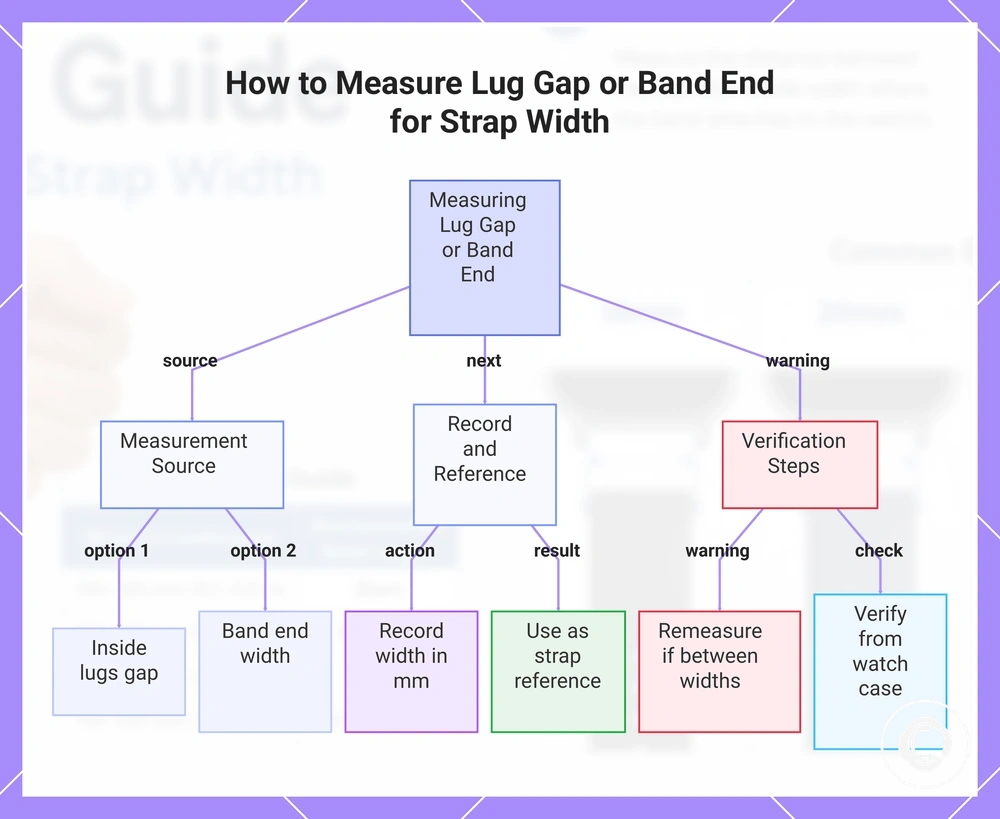
Check the stamped size on the old band or watch underside
A stamped size or printed size is a secondary confirmation mark that may show the band width on the old band or watch underside. The width number can help confirm a measured gap, but stamped size is confirmation, not proof.
If the old band is aftermarket, worn, or damaged, the marking may be missing, hard to read, or less reliable. Compare any marked width against the measured gap and remeasure when uncertain.
- Check the old band for a stamped size, printed size, or strap marking near the band end.
- Look at the watch underside for a width number or underside mark, but do not assume every watch shows one.
- Read the marked size as a millimetre width value and compare it with the measured gap.
- Remeasure if the old band is aftermarket, worn, damaged, or inconsistent with the measured gap.
How to measure wrist size for band length
Measure wrist size by determining wrist circumference and using that measurement to guide a band length decision. Wrist circumference is the primary reference for choosing strap length.
If a measuring tape is unavailable, a string or paper strip can be wrapped around the wrist and then measured with a ruler. Recording the wrist measurement in millimetres helps keep sizing consistent and supports later unit conversion when needed. The process depends on accurate wrapping, a snug fit, and unit conversion.
- Place a measuring tape, string, or paper strip around the wrist where the smartwatch is usually worn.
- Wrap the measuring tool with a snug fit, keeping it secure without excessive tightness.
- Mark the overlap point on the string or paper strip if a measuring tape is not being used.
- Measure the marked length with a ruler and record the wrist circumference in millimetres.
- Convert the wrist measurement to the preferred unit if needed and use the result to guide the strap length decision.
If the smartwatch is intended for daily wear, a slightly less restrictive fit may feel more comfortable over longer periods. For tighter activity use, the preferred fit may differ, and comfort can depend on clasp style, adjustment range, and individual preference.
This chart shows the step-by-step process to measure wrist circumference and apply it to choose the right band length, including key actions and fit considerations.
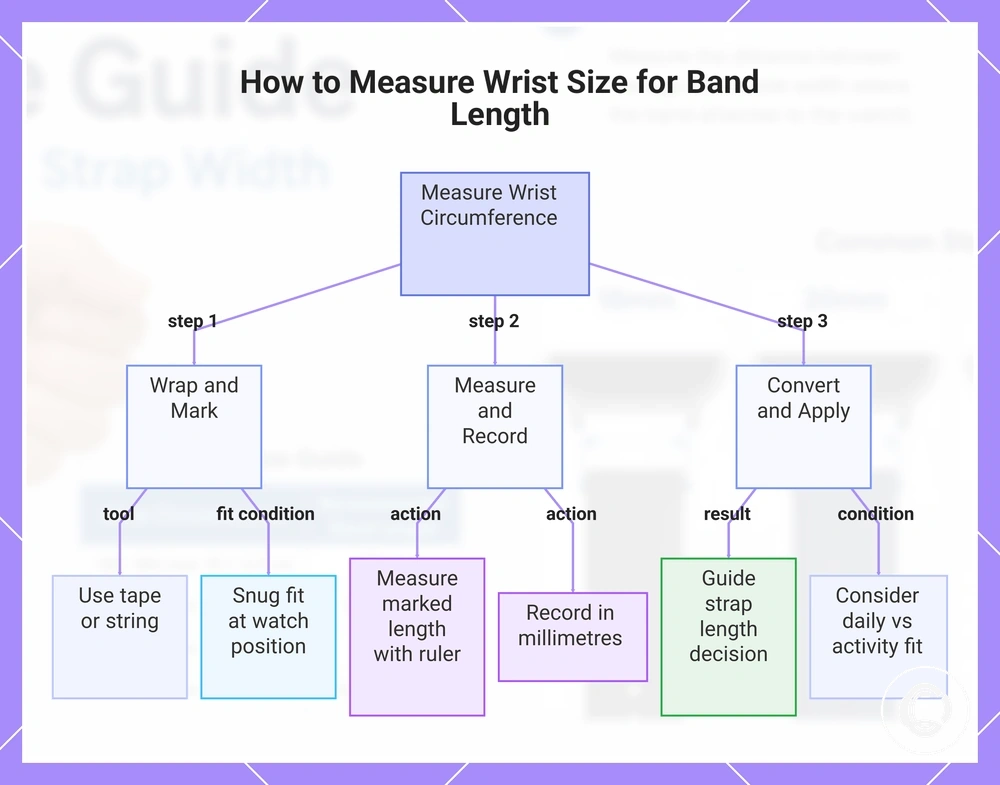
Measure with a tape, string, or paper strip
Measure wrist circumference by wrapping a tape, string, or paper strip around the wrist and reading the resulting length. The measurement starts with a snug wrap and ends with a ruler reading, making tape, string, and paper strip practical measurement tools.
- Wrap a measuring tape, string, or paper strip around the wrist at the intended wearing position.
- Keep the wrap snug without pulling too tight or leaving it too loose. If the wrap shifts noticeably, remeasure before continuing.
- Mark the overlap point where the string or paper strip meets itself.
- Lay the marked length flat and align it with a ruler before reading the measurement.
- Read the wrist circumference and convert the marked length to millimetres if needed. For example, a marked length taken from a paper strip can be recorded in millimetres for later comparison.
Match wrist circumference to total strap length
Wrist circumference becomes a strap-length decision by comparing the wrist measurement with total strap length and adjustment allowance. A short strap, regular strap, or long strap category is selected by checking how wrist circumference maps to a strap-length category.
If a wrist measurement falls between two band length categories, remeasure and compare the usable strap length before deciding. Clasp position, adjustment allowance, and remaining range can influence the decision for in-between wrists.
| Wrist measurement | Strap length category | Adjustment check | Decision cue |
|---|---|---|---|
| Small wrist circumference | Short strap | Check tail length and adjustment allowance | May suit when enough remaining range stays after fastening |
| Mid-range wrist circumference | Regular strap | Check usable strap length and clasp position | May suit when adjustment range remains available |
| Large wrist circumference | Long strap | Check clasp allowance and remaining range | May suit when enough fastening range remains |
| Between categories | Compare adjacent categories | Remeasure and check adjustment allowance | Choose conditionally based on usable strap length |
20mm and 22mm smartwatch band size differences
20mm and 22mm smartwatch bands are different band width sizes and should not be swapped unless the watch design explicitly supports it. The difference is measured in millimetres across the strap width, so the lug gap needs to match the band width. These sizes should not be swapped unless supported.
A 20mm band is made for a 20mm lug gap, while a 22mm band is made for a 22mm lug gap. The comparison is between physical strap width and the watch-side opening, not a style ranking. The key match is lug gap to band width.
If the wrong width is used, a narrower band may create movement risk, while a wider band may create pressure or non-fit at the connection point. A 2mm difference can affect visual proportion, but the main issue is the physical-fit and compatibility consequence.
| 20mm band | 22mm band |
|---|---|
| Measures 20mm across the band width | Measures 22mm across the band width |
| Requires a matching 20mm lug gap | Requires a matching 22mm lug gap |
| May leave movement if used in a wider opening | May create pressure if used in a narrower opening |
| Risk if swapped: movement risk or loose fit | Risk if swapped: pressure, non-fit, or connection mismatch |
Choosing a size when measurements fall between ranges
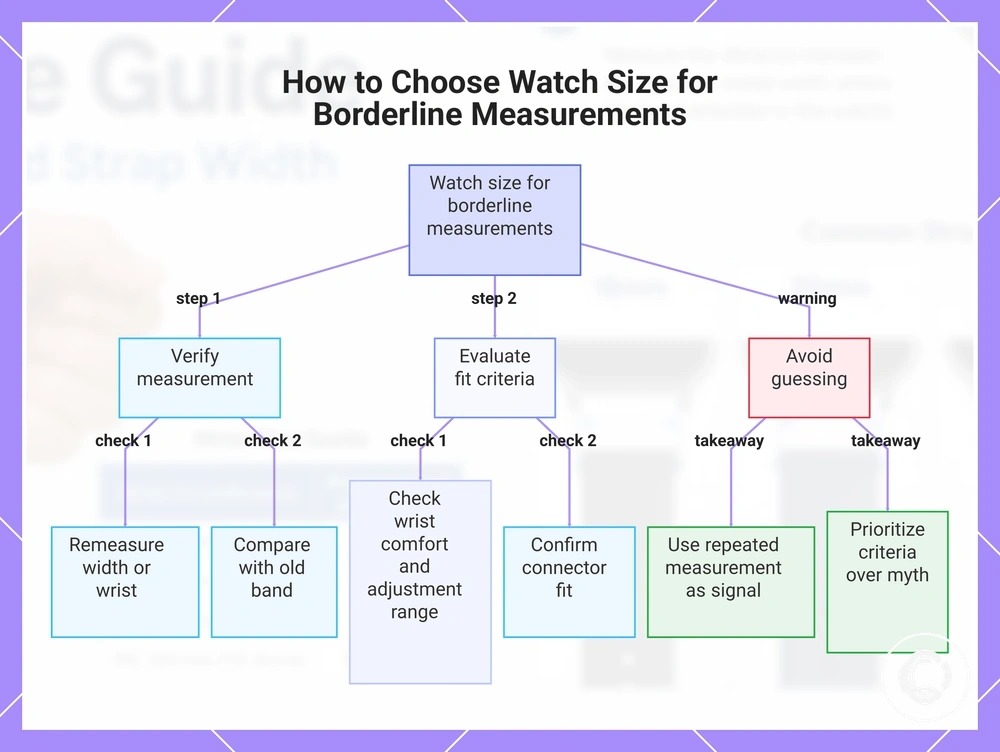
When measurements fall between ranges, the safer size decision depends on criteria rather than guessing. A borderline measurement can come from tool angle, worn edges, wrist position, or a value that sits near a common size break. Border measurements need criteria.
- Remeasure the width or wrist value in millimetres to check whether the result repeats.
- Compare the old band, size label, and measured gap when the old band is available.
- Check wrist comfort tolerance before choosing a shorter or longer strap length.
- Review the adjustment range to see whether enough usable length remains after fastening.
- Confirm connector fit before treating a close width as usable.
- Avoid guessing when the value changes between readings or the old band does not confirm it.
Remeasure first. Use the repeated value as the stronger signal. If the second reading does not match the first, prioritize remeasurement before choosing.
If wrist length is borderline, adjustment range and wrist comfort tolerance may decide whether a shorter or longer strap category is more suitable. If lug width is borderline, connector fit and the old band should be checked before treating the size as usable. These fit checks before choosing help separate a close measurement from a reliable size decision.
The common myth is that an in-between size means you should automatically size up or size down. The safer truth is that the choice depends on repeatable measurement, old band confirmation, connector fit, and the comfort trade-off between tighter hold and remaining adjustment range.
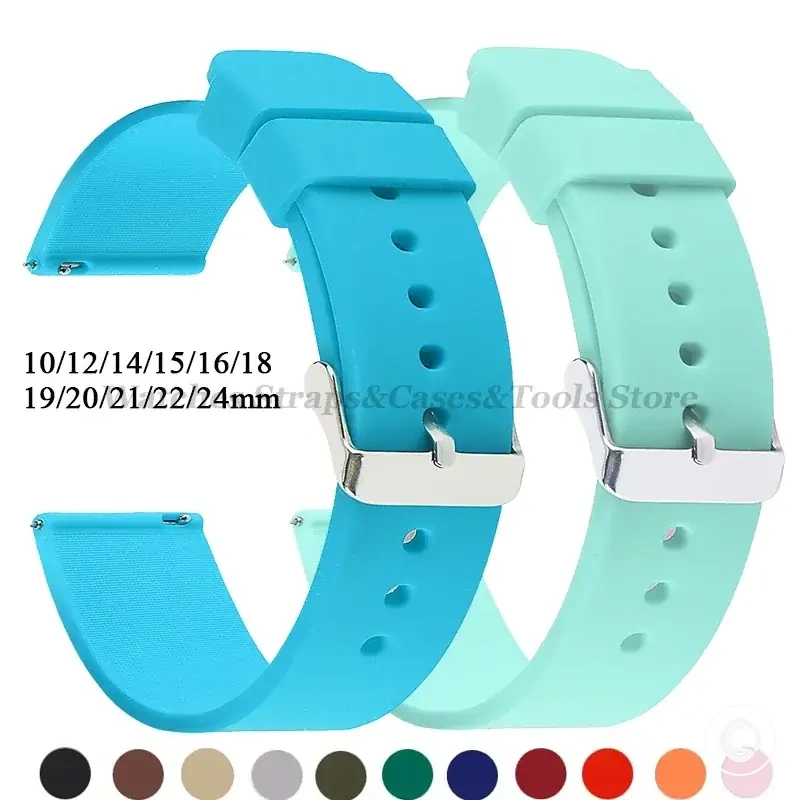
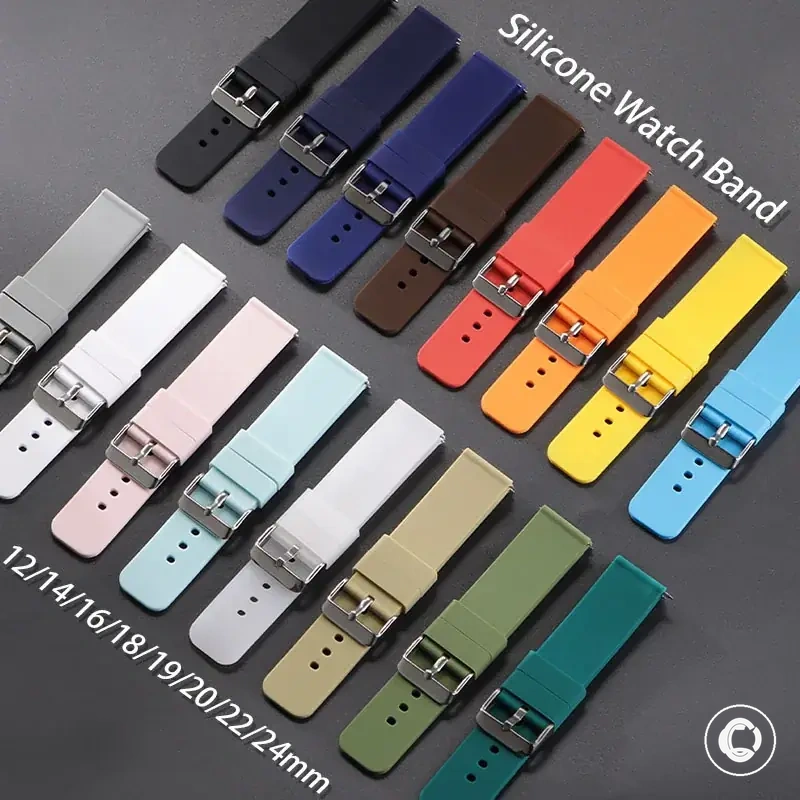
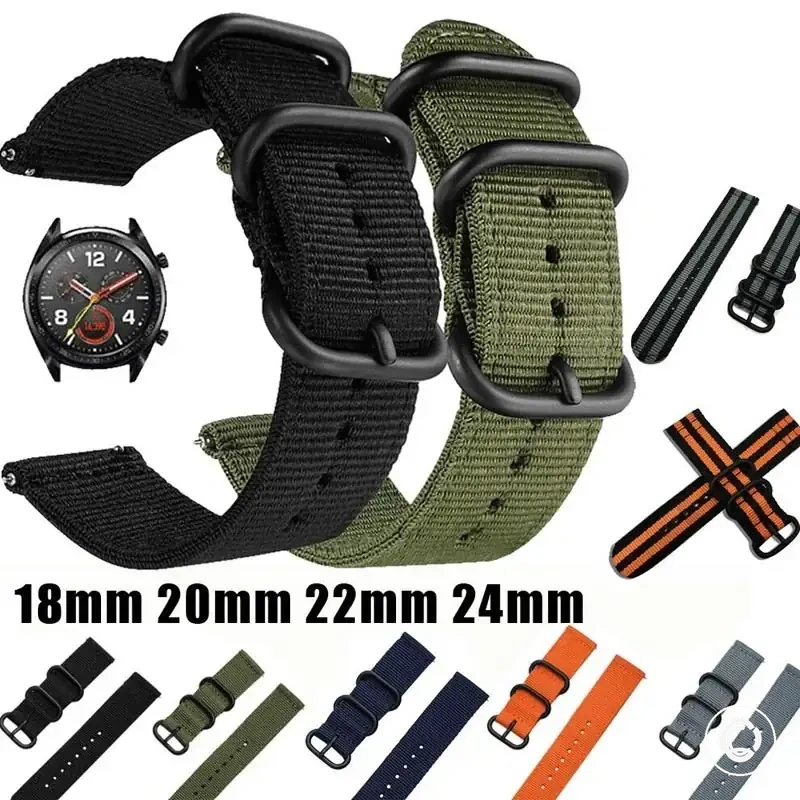
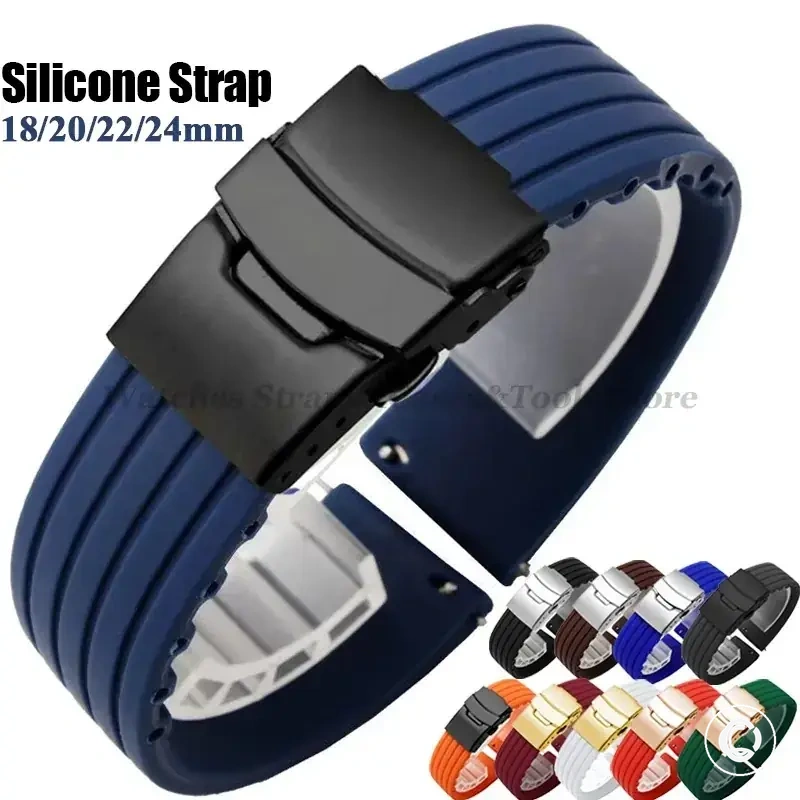
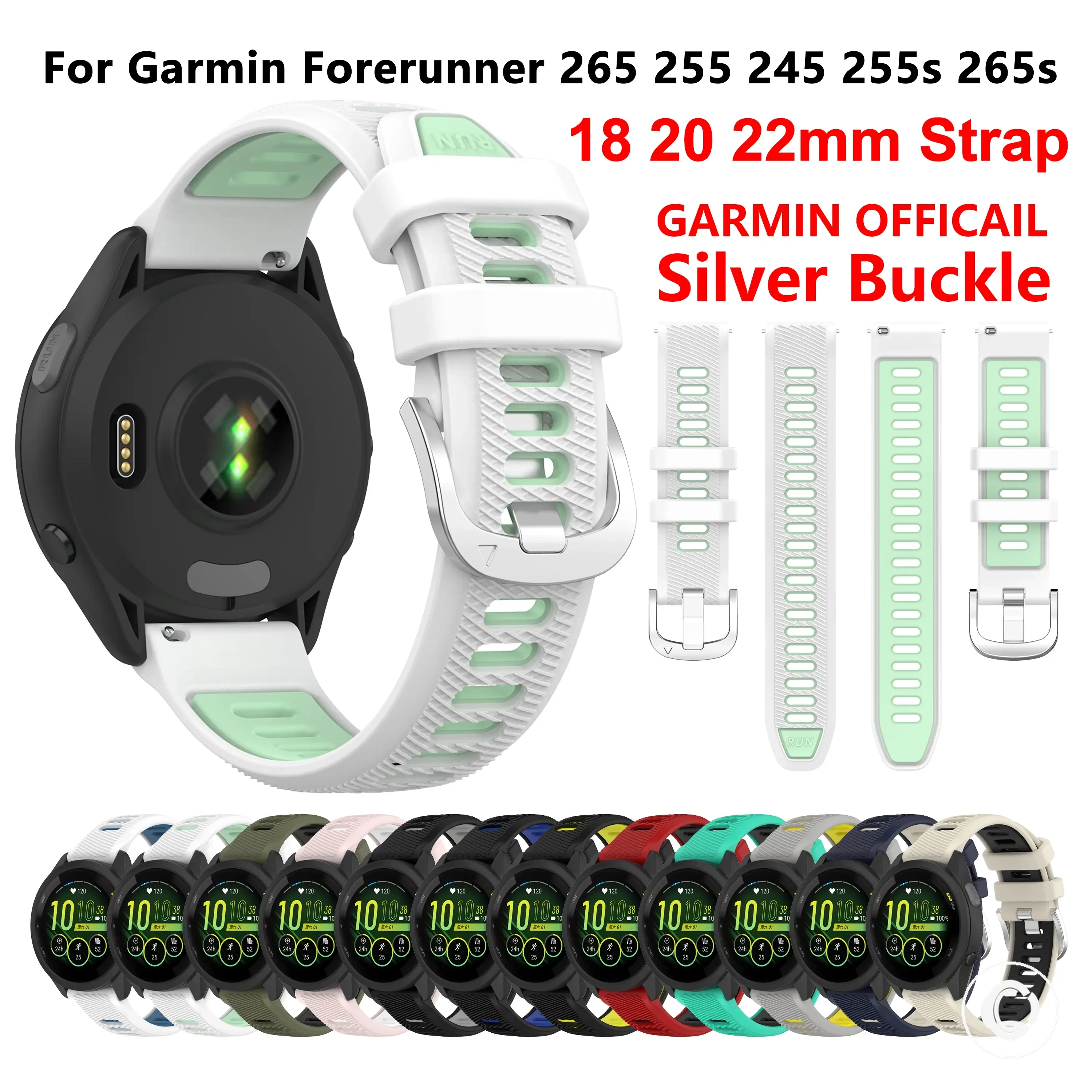
Here are product examples that may make comparison easier. Before buying, always review the compatibility criteria, essential features, and product details.
This chart shows the criteria-based steps to make a reliable size decision when wrist or lug measurements fall between standard ranges.
Final size checks before replacing a smartwatch band
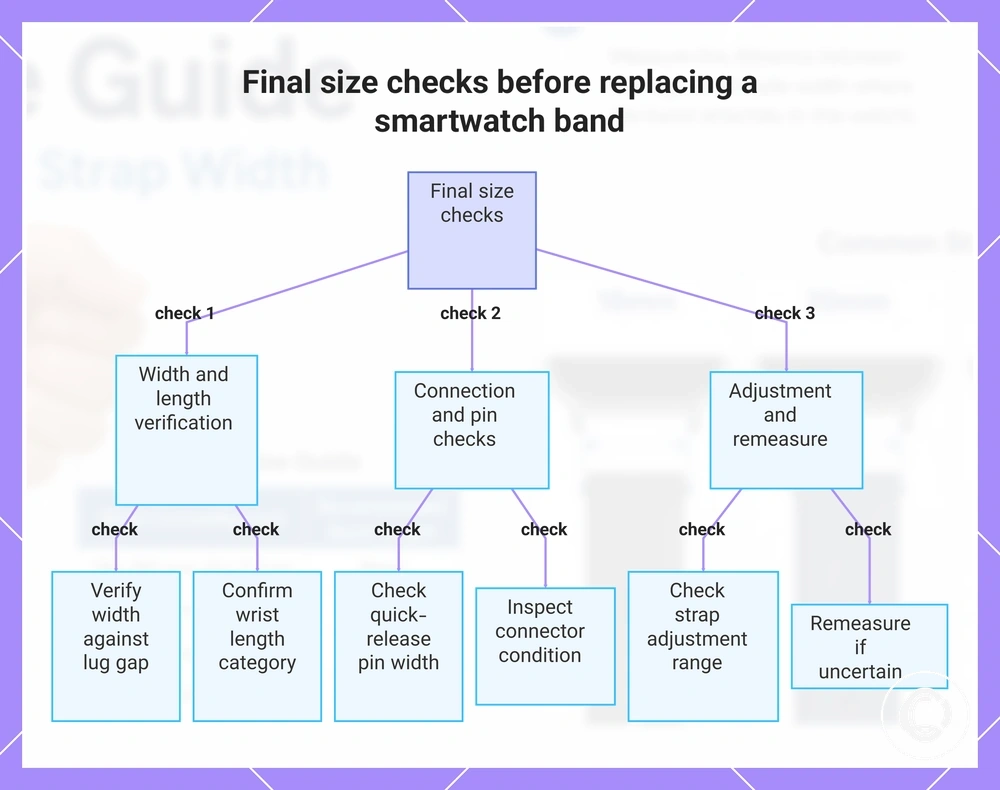
Final size checks reduce fit mistakes before choosing a replacement band. They confirm that the measured width, wrist length category, and connection details still align before replacement, so final checks work as verification.
- Verify the measured width against the lug gap or old band before treating it as the replacement band size.
- Confirm the wrist length category so the strap length matches the intended small wrist or large wrist adjustment range.
- Check quick-release pin width because an unsuitable pin may affect seating and create fit risk.
- Inspect connector condition for worn, bent, or unclear connection points before relying on the size reading.
- Review adjustment holes to confirm there is enough range after the band is fastened.
- Check tail length so the strap does not leave too little or excessive remaining length for the wrist range.
- Remeasure any value that sits between common sizes or does not match the old band.
If the replacement band is being chosen for a small wrist or large wrist, adjustment range may matter as much as the size label. If the quick-release pin width or connector condition looks uncertain, treat the result as a pre-replacement check rather than a finished fit decision. Sizing checks stop at verification; replacement steps belong to a separate installation process.
This chart shows the verification checks to perform before choosing a replacement smartwatch band, reducing fit mistakes.
Quick-release pin width must match band width
A quick-release pin must match the measured band width for secure seating in the lug gap. Pin width, band width, and straight-lug fit should align before choosing a replacement band because pin width must match band width.
For example, a 20mm quick-release pin is intended for a 20mm band width, while a 22mm quick-release pin is intended for a 22mm band width. If the pin width or band-end width does not match the lug gap, the result may increase the risk of movement or non-fit.
Verification checklist:
- Verify that the quick-release pin width matches the measured band width.
- Check that the band-end width aligns with the lug gap before relying on the size.
- Confirm that the quick release bar can achieve secure seating within the connection area.
- Inspect straight-lug fit and spring-bar seating before treating the size as compatible.
- Remeasure if the band width, pin width, or lug gap appears inconsistent.
- Avoid mixing 20mm and 22mm sizes because the wrong size may increase movement risk.
Small wrist and large wrist fit checks
Small wrist and large wrist fit checks confirm whether a secure fit and comfortable fit remain possible after width and length have been measured. These checks focus on adjustment range and confirm that small and large wrist checks validate adjustment range.
Diagnostic checklist:
- Check whether the strap tail remains manageable after fastening and does not indicate an exhausted adjustment range.
- Review hole position to confirm that fastening does not occur at the extreme end of the available adjustment range.
- Verify that clasp placement sits comfortably without forcing the closure toward either end of the strap.
- Confirm sensor contact remains consistent and that the band is not obviously too loose or too tight.
- Look for signs of excessive movement that may indicate a too loose wrist fit.
- Check for excessive restriction that may indicate a too tight wrist fit.
- Consider a short strap or long strap if adjustment range no longer provides a practical fastening position.
If a small wrist requires fastening at the last available hole, the remaining strap tail and adjustment range may become limited. If a large wrist requires fastening at the first available hole, a long strap may provide a more suitable combination of strap tail, hole position, and clasp placement.
When adjustment range no longer supports a practical fastening position, moving to a short strap for a small wrist or a long strap for a large wrist may be appropriate. This condition often appears when the current hole position leaves little remaining adjustment range, explaining when a short or long strap may be needed.
If sensor contact changes because the band shifts or feels unstable, reassess the local fit checks before changing sizes. For broader diagnosis beyond these checks, see loose or tight band fit.